Santal
Mythology and Creation Concept
All
the major races in the world have their own beliefs with
regards to their creation as also that of the universe and
human beings. The Santals too have their own unique and
elaborate creation and origin myth. The religion practiced
by the Santals is animistic but it does not imply of it
being pagan as is believed by those who boasts of a text-based
religion. 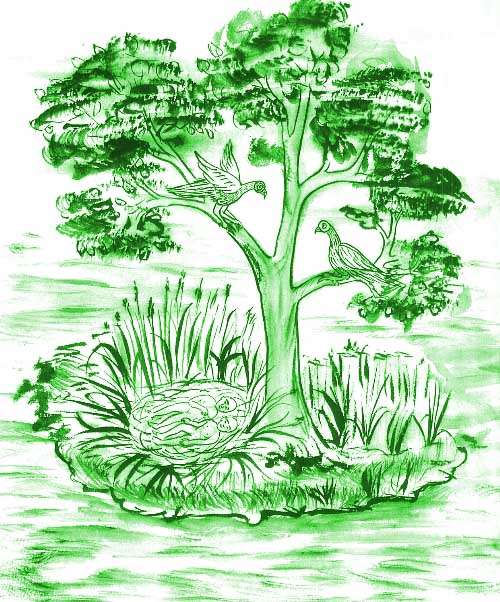
A
complete analytical account of the creation concept was
told by Kolean, recorded by Skrefsurd (1887) and translated
into English by Rev. Bodding in 1942. In the absence of
any script the rich traditional heritage continued to low
for generations through oral renditions alone.
Santal
Mythology
The Santals are great storytellers and
have a daily practice of surrounding their elders to hear
stories. There is no doubt about the history of the Santals
being one of the world's oldest tribes. They are the most
researched tribes. Anthropologists are of varied opinion
about the time of their existence on the earth. But given
the documented versions, the Santals emerged between the
food gathering period that is nine million years before
now and the early agricultural period that is about nine
thousand BC of the history of human civilization. Yet with
a history as old as this they cannot pride themselves of
a documented history for they have no ancient books written
by them, as they were not literate.
 ^TOP^
^TOP^
Their
culture is based on oral tradition as also their religion,
which has only now been documented, by sociologists and
anthropologists. There are some peculiar straits in their
character and personality. They hold an unassailable religious
faith revolving around their gods such as Maran Buru, Moreko
Turuiko, Jaher Era and Gosain Era, which can warmly be felt
in their daily chores and customs. These Gods are represented
in nature, trees, mountains, forests and stones. Yet they
have no organized religion, no temples and not even a time
and place for worship. They have a strong stigma towards
spirits (Bonga) who are considered to be omnipresent and
malevolent. Their lifestyles are guided under the watchful
eye of these spirits. They have elaborate appeasement sessions
for these bongas and every home has a specified area to
worship and appease the bongas. Unlike the sister customs
and cultures of their neighbors, worshipping is not one
of the prime facets of life and yet they have a dogmatic
belief in supernatural and eulogize the powers of the almighty
in every stage, event and even their destiny. Contradictions
indeed but yet that is what is a reality with the Santals.
Rituals and beliefs are interwoven in their daily and routine
life. They have garrulous vocations related to their festivals,
their cleansing ceremonies done at their birth, marriage
and on their death and their traditional outlook and belief
in the continuation of life after death.
The Santals call themselves Hor Hopon, meaning the child
or children of human beings. It is the diction of others
that they are known as Santals, Santhal. Saontar and Sotar
to be regionally classified. In the State records they are
mostly found either as Santal or Santhal. The Santals have
been in India since time immemorial and complementing their
antiquity an eminent anthropologist P.C.Biswas writes in
"Primitive Religion, Social Organisation Law and Government
among the Santal, 1935 that " If there is any culture
which still carries on the impress of the underlying philosophic
speculation and order of the thought that was widespread
in India prior to the rise of the Dravidian culture, it
was very likely the belief and social order of pre-Dravidian
Santals…So in the pre-Aryan and pre-Dravidian culture
of India the Santals…. Stand in the lime light"
^TOP^
Different
Researchers have recorded various versions of creation narratives
and different writers have made use of them with moderate
variations. One of this is contained in the Santali book
" Horkoren Mare Hapramko Reak' Katha " which was
first published by Rev L.O.Skrefsrud in 1887 (Santal Mission
of the Northern Churches) as a guide for the Santals, especially
in the customary matters and also on account of its ethnological
value. P.O. Bodding re-edited the book in 1916 and 1929.
The renderings in the book are a faithful translation of
the narrative of an old guru Kolean, the elder, whom Skrefsrud
found to be the best authority he has been able to locate.
Kolean belonged to village called Pabea in the district
of Manbhum to the southwest of the Santal Parganas. The
other one is authored by Rev. A.Campbell titled "Santal
tradition" published in 1892. While there are marginal
variations in the contents of these two publications, the
theme is as follows:
Origin of Human Being
Man
was born towards the direction of the rising of the Sun
(The east). Initially there was only water and underneath
water was the earth. Then Thakur Jiu (The Lord) created
living beings in water - the crab, the crocodile, the alligator,
the Raghop Boar fish, the 'Sole' prawn, the earthworm, the
tortoise and others. Then Thakur said ' whom shall I now
make? I will make man". He decided to make two of them
and went ahead to make one pair with the earth soil. As
he was going to put life in them, the day-horse (Siv sadom
or the horse which has been kept locked) came down and trampled
them to pieces and left. The Thakur was grieved. He then
decided that that he would not make them on the earth instead
he shall make birds. He then proceeded to make Has and Hasil
(Swan and the female) pulling the material from his chest.
Thereafter, he breathed on them and they became animated
and flew upward. They moved about flying but could not alight
anywhere. They alighted on the palm of the Thakur. Then
the horse of the daylight came down to drink water. When
he was drinking water he spat some froth from his mouth
and left. It floated on the water; thereby foam was created
on the water. Thakur thereupon said to the two birds to
alight on the foam that they did. Now they would travel
all over the ocean by the foam, which carried them as a
boat. Then they implored Thakur," We are moving about,
that is so, but we do not find any food"
^TOP^
This
made the Thakur call the alligator. He came and Thakur told
him to bring up earth. The alligator said . ' if you say
so, I can bring it up" It went down to the bottom of
the sea and as he was bringing up earth ( on his back) all
got dissolved in water. Thakur -Jiu called the prawn. He
was also told similarly to bring up earth. He complied with
and went down to the bottom of the Sea and as it was bringing
earth with its pincers, all were dissolved in water. This
made Thakur Jiu call the raghop boarfish. He came. Thakur
asked him whether he would be willing to bring up earth.
The fish agreed and having gone down in the water he bit
the earth. He was bringing some of the earth in his mouth
and some on his back but in the deluge of water, all the
earth got dissolved. Thereupon Thakur called the stone crab
and the Thakur likewise requested him. It went down the
sea and while it was on its way back with the earth with
its claws, all the earth was dissolved. The same procedure
was followed with the earthworm that the Thakur called thereafter.
It promised to bring the earth provided the tortoise stands
on the water. The tortoise agreed to the request of the
Thakur Jiu and as he stood on the water Thakur chained his
four legs in the four directions. The tortoise became immovable
on the water. Then the earthworm went down to reach the
earth while his tail rested on the back of the tortoise.
He started eating earth from down below and through his
tail it reached onto the back of the tortoise. It continued
to heap earth on the tortoise till he brought up enough
for the whole earth.
Thereafter
Thakur levelled the earth with a harrow. While harrowing,
the earth got heaped up in some places; this became mountains.
Then when the earth had been brought up and levelled, the
foam that was flowing on the surface of the water stuck
to the earth and as Thakur sowed sirom seed (The dhubi grass)
on this foam, the sirom plant sprang up first. The Karam
tree (Adina cordifolia); was created thereafter followed
by the rope sarjom, the labar atnak, the ladea matkom and
later, the remaining varieties of vegetation. The earth
became firm thereafter. Thereupon, having made a nest in
a clump of the sirom plants, the two birds laid two eggs.
The female bird would sit on the eggs and the male bird
would locate and bring food. After some days from those
two eggs, two human beings were hatched, one boy and one
girl. They implored Thakur. " How can we bring them
up ". Thakur Jiu gave them cotton wool and said to
them " whatever you eat, squeeze out the juice of it
in this cotton wool and give it to them to suck it. In this
fashion they grew up and started toddling.
^TOP^
As
the two human beings were growing, the anxiety of the birds
also grew, concerning where to keep these two. So they sought
Thakur again. Thakur told them," Do fly around and
find a place for them to stay". Then they flew towards
the setting of the sun; they discovered Hihiri Pipiri. Having
returned they told Thakur of this. Thakur told them to take
them there, which they did. The names of these two human
beings were Haram and Ayo. Some people call them Pilcu Haram
and Pilcu Budhi. They grew up eating sumtu bukuc grass and
sama ghas. They had no clothes, they were both naked; yet
they were unashamed, and they lived in great peace.
One
day Lita (Which is said to be the real name of the principal
bonga of the Santals, always referred to as Maran Buru)
came and called them out. " Where are you grandchildren,
how are you? I am your grandfather, I have come to see you,
you are quite well, but one of the greatest joys you have
not realized yet. Brew rice beer, it is very tasty "
He taught them the preparation of the ferment for rice beer
and showed them the herb. They dug its root and brought
it. Under the guidance of Lita the procedure of preparation
was religiously followed. The brew was prepared and was
served in three cups of leaves.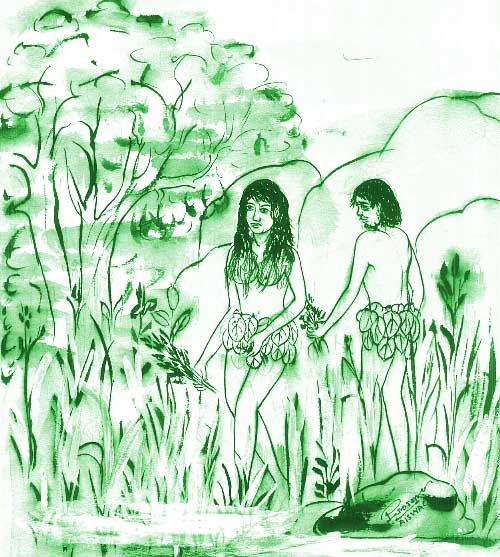 One of these was offerred to Maran Buru as libation and
they drank the remaining two cups. While drinking they began
to flirt with one another. They drank it all up and were
quite stupefied. The night advanced and they slept together.
When it was daybreak, Lita came again and called them out.
They regained consciousness and recognized that they were
naked which made them greatly ashamed. They told Lita that
having been intoxicated they have done something wrong.
Lita assured them that nothing will happen and he went away
smiling. Pilcu Haram and Pilcu Budhi made coverings of banyan
leaves to cover the bodily part which modesty requires to
be covered. In the course of time they got seven sons and
daughters. The name of the eldest boy was Sandra, followed
by Sandhom, Care, Mane and Acaredelhu. The eldest girl was
Chita followed by Kapu, Hisi and Dumni. The names of others
were forgotten.
One of these was offerred to Maran Buru as libation and
they drank the remaining two cups. While drinking they began
to flirt with one another. They drank it all up and were
quite stupefied. The night advanced and they slept together.
When it was daybreak, Lita came again and called them out.
They regained consciousness and recognized that they were
naked which made them greatly ashamed. They told Lita that
having been intoxicated they have done something wrong.
Lita assured them that nothing will happen and he went away
smiling. Pilcu Haram and Pilcu Budhi made coverings of banyan
leaves to cover the bodily part which modesty requires to
be covered. In the course of time they got seven sons and
daughters. The name of the eldest boy was Sandra, followed
by Sandhom, Care, Mane and Acaredelhu. The eldest girl was
Chita followed by Kapu, Hisi and Dumni. The names of others
were forgotten.
^TOP^
The
story of creation went on like this. It goes on to describe
as to how the community grew, how the first generation of
the community was destroyed by Thakur Jiu by fire from heaven
because of their sin and how one pair survived the disaster
and how the next generation grew up and wandered from place
to place. Kolean 's report of the creation and the wanderings
of the people end here. According to a statement towards
the end of the book the dictation was finished on the 15th
of February 1871. P.O.Bodding added some more stories after
rendering the views of Kolean on grounds that some Santals
had actually narrated things, which Kolean did not mention,
and " This does not exclude the possibility of our
learning something from other sources ". The additional
stories gathered by Bodding are marginal variations of the
main story on the creation concept. The role of Maran Buru
in the first story emerges at the end whereas in the updated
version he has a predominant role in the formation of earth
and in fact has been substituted in place of Thakur Jiu
in the first story.
The
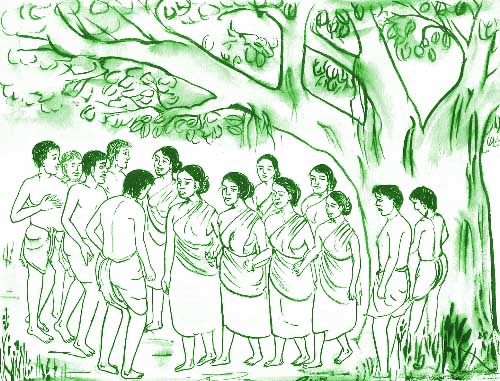
other important addition in the later version is the story
of how the mankind were divided into separate races. Bodding
says that Kolean does not mention how mankind was multiplied
and divided into various races and formation of sub-septs.
The text which is open to ethnologists" is a genuine
account of Santal traditions and institutions taken down
from the mouth of Kolean who had learnt it from his own
teacher. The Santals have elaborate ceremonies for propitiation
of gods and spirits in the form of sacrifices performed
by the priests during ceremonies and festivals and certain
rites performed by the members of the individual households.
The religiuons is not considered to be the moral custodian
as that authority is vested in the village councils, which
acts as the sole arbitrator of wrongs committed by its people.
Not being a scripture based religion there is pratically
no contradictions between the ideal and the practiced forms.
The functioning priests do not play the role of religious
preachers unlike the other religions. At the discreation
of the people nominating them to public offices of the village
council they do not have any compulsive role as moral gurdian
of the society, which again is different from other societies.
These traditional tales are being carried from generations
to generations without any significant corruption, as "they
are evidently the result of a comparatively long development
". There are a strong influence of Hindu culture and
language in the renderings although the whole conception
may not be categorised as Aryan. The narrative penned nearly
a century and quarter ago has the same relevance to the
present day Santals and to customs, which had the occasions
to be influenced by such a rich culture. The history has
also the distinction of being recited twice in connection
with the life of every Santal, first at the Caco Chatiar,
when a child is ceremoniously given full social right, and
finally at the bhandan, the funeral ceremony, when the deceased
is handed over to the next world and to the care of the
departed ancestors.
^TOP^
The
Santals as a tradition are a wandering lot and given an
opportunity they are inclined to do so even today. The nomadic
state possibly owes to the fact of their dependence entirely
on forest and the fact of a particular chunk of forest as
a source of sustenance continues to change. W.W.Hunter in
"The Santals" says that ' in marked contrast to
the Kolarians of the Munda and Ho divisions, the Santals,
as a rule, care little for permanently locating themselves.
A country denuded of the primeval forest which affords them
the hunting ground they delight in shifting and the virgin
soil they so much labour to claim, does not attract them;
and then, through their own labor, the spread of cultivation
has effected this denudation, they select a new site, however
prosperous they may have been on the old, and retire into
the backwoods, there their harmonious flutes sound so sweeter,
their drums find deeper echoes, and their bows and arrows
may once more be utilized.
The
Santals have been influenced by the traditional role of
socialism. As a first step towards this credence they have
the public ownership of land. At the founding of a new village,
each Santal receives land not by individual seizure but
by village decision, and it is only when he has brought
his holding under cultivation, that he acquires a permanent
right to remain in possession. He has the alternative to
exchange his land with another Santal but only under the
sanctity of the approval of the village headman. This is
required to be substantiated by the Sub-divisional officer.
He cannot otherwise transfer the land out of his family.
Despite a established system of land management.
Migration
- In Search of Betterment
The tradition of their
ancient migrations are rendered obscured by the accession
of dissolving views to which this nomadic habit introduces
us, but they nevertheless tenaciously cling to a wild and
remote tradition of their origin… But though prone
to change, the Santals are not indifferent to their personal
comfort, and are more careful in the construction of their
homesteads and villages then their cognates. Their huts,
with carefully formed mud walls and well raised plinths
and snug verandahs, have a neat and, owing to their love
of color, even a gay appearance. They paint their walls
in alternate broad stripes of red, white and black- native
clays and charcoal furnishing the pigments; Moreover, the
houses are kept perfectly clean, and, by means of partitions,
decent accommodation for the family is provided'. Besides,
there is also another aspect of their character where stability
or concern for the future is always left to the almighty.
The Santals consider the man as a creation of God who send
them to the earth at his own will and again decide on when
they are to be called back. To an extent such a school of
thought would result in an emancipation that the sustenance
of such a creation of God is the responsibility of God and
they are mere performers of the duty entrusted to them.
Obviously, a tribe who do not accept his existence, sustenance
and well being as his own creativity and a result of his
own efforts shall find genuine excuses to while away his
time in praising the supernatural.
^TOP^
They
are, as a class, unable to accept complete civilization
and as such lag behind their neighbors in maintaining their
position amongst other communities. The problem of dire
economic straits compels them to learn some vocation for
a while but since a fixed vocation alike a fixed habitation
is against their tenets they seek other pastures to lighten
up their customary manners. There are historical evidences
to show that the tribe migrated to save themselves from
cultural onslaughts and preserve their freedom. They pick
up certain habits of the new surroundings only to be protected
from being called aliens entirely. However, due to their
alienated character they do not understand how to gain maximum
from the new adoption. To improve in this direction they
will have to alter many of their ingrained habits as well
as their mode of life. Having been close to the Bengali
culture for centuries for geographical compulsions they
have not been able to adopt even a fraction of their traditional
aspects of economic security. This again is interlocutory
to the fact that they have not learnt the value of money
although the relevance of a paisa is important to them.
This economics appears to be far beyond their capacity and
they suffer from it. And so in their forest surrounding
they depend only on barter system and not money based transactions.
Rationally there, they are vulnerable to unequal transactions
where the worth of the bartered element may not be worth
the compensatory element given away.
The
Santals are good tenants and are second to none in India
in so far it concerns cleaning of the forest and also except
in manuring, in making the soil ready for cultivation. The
fact is accepted, known and taken benefit of by the other
class of people. The wandering tendencies of the Santals
have much to say to their tenets of simplicity. As already
said the Santals is the best clearer of jungles in India
because of themselves originally belonging to the jungle.
But they know nothing of agriculture nor do they develop
such knowledge. Being bad in economics they got into the
hands of moneylenders who would get on the fields cleared
by the Santals after much labors at a measly pittance. They
did not have the knowledge that instead of borrowing money
from the moneylenders in barter, large tracts of lands cleared
by them at such immense labour could well have been manured
for agricultural purposes to earn money instead of getting
into the scheme of the clever moneylenders. Having lost
the cleared lands they would endeavor to some other places
always towards the rising of the Sun. Although they were
a prolific race but being brought to such a pass that they
did not have enough land for sustenance either the whole
family or some of them will go away to find a fresh tract
of jungle to clear it afresh. And again the repeat happening
of the moneylenders chasing them there too to further hoot
them off to oblivion.
^TOP^
The
Santals always live in villages. They are never found to
be dwelling alone. The dwelling areas are invariably tracts
of forestland. Since habitation is a changing factor for
adivasis, an account of the selection process for a site
for building and establishing a new village is of interest.
There is a long list and lengthy process of rituals connected
with the setting up of a habitation. The architectural layout
is also defined and so is the source of sustenance which
is unfailingly nearby. A pre-determined forest area is discussed
upon as a preliminary hunt. Three or four men proceed with
a leader to inspect the site. The moment they step into
a forestland there are notional linkages with every event
happening thereafter. For instance, the flying of quails
are regarded as symbiotic to the fact that some day in future
a village established here would be deserted. But if they
see that birds are sitting quietly on their eggs, of if
they meet a tiger or see footmarks of a tiger that denotes
that the village found here shall be prosperous and thrive
and that they must settle down contently. The selected site
shall thereafter be further investigated for a place where
there is a high ground where rice fields can be prepared,
and where water is readily accessible. A subsequent day
is fixed thereafter for testing the omens. The rituals for
this purpose consists of, one speckled and two white fowls,
a little sun dried rice, oil, sindur and water in a narrow
necked earthenware pot called "Thili". The leader
ventures into the forest to place these things in a sequential
manner on the place where he intends to build his house.
The other connected rituals are performed and the team led
by the leader departs to spend the night elsewhere. They
return the next morning to investigate the state of the
things placed at night before depending upon the position,
the impact of omen is decided. The signal of a good omen
convinces them of their decision to establish a village
there. The leader, who is to become the headman of the village
cuts down the first tree. Once the village is ready and
farmland divided the exodus takes place. These are generally
done in the month of Phalgun and Chaitra (middle of February
to middle of April) Running along the middle of the site
a clear space is left for the village street and near the
end of this is found the sacred grove.
The
form of architecture of a santal house is called Bangh Orak.
It is rectangular in form, its breadth being two -thirds
of its length. Another form of house is called Calom Orak
having four sided roof. The houses invariably have a destined
place called "bhitar", the closet for the ancestors.
The houses have earthenwalls. These besides being cheap
are easy to construct. The present day Santal houses have
places as sheds for cow, sheep, buffallo and goat. When
the family grows bigger , more houses are built but not
with the bhitar, the closet for the ancestors continues
to be with the house first built. The Santals are always
in the look out for natural springs to fetch water. Water
from pools, tanks, streams and rivers are also used. Individual
families depending upon their status also dig wells. There
the men gather ritually in the evening to have talking sessions
and women gossip there in the afternoon to discuss everything
earth.
The
Santals had a tradition of their ancestors, which is peculiar
in nature but is still followed to some extent. It appears
that each man used to occupy and owned as much land as he
could cultivate in any one season. At the end of the season
all lands were given back to the village community for redistribution
during the next year. A part of this system is still in
vogue. The Santals do not learn the conventional method
of agriculture and derive no benefit from the latest form
of cultivation. They don't understand the benefits of weeding
and manuring or of changing crops. They don't take proper
care of their cattle. When paddy is harvested the cattle
roam about in the fields freely. Possibly this attitude
has been developed because of uncertainty of permanent habitation
which again is a result of their migratory tendencies. Another
illustration of their migratory nature is proved by the
fact that they do not gather too many household things in
the course of their normal lifestyles. The Santals have
no furniture or eating accessories like spoons or forks.
They generally prefer to spread out their food on the ground
or the courtyard on utensils, which is their only worldly
posessions. This is generally neatly plastered with cowdung,
dried and carefully cleaned before sitting down for food.
A distinct Hindu culture has crept into their habits related
to the fact that when there are no utensils to serve the
food they use cups and plates made of leaves. These are
used once and thrown away. Usage of such utensils for more
than once is considered unhealthy practice and against all
norms of cleanliness
^TOP^



 AISWACS
 Santal
Hul - 150
Santal
Hul - 150