Functional
Theory of Religion
Certain
sociologists like Emile Durkheim, Malinowsky and Radcliffe
- Brown in order to explain religion and various religious
phenomena, advocated 'Functional theory'.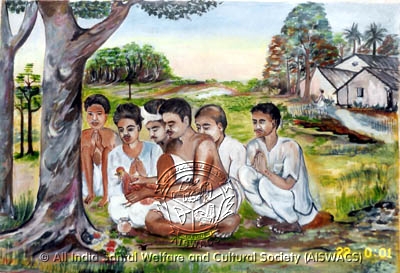 According to this (Functionalist) theory, Societies are
made up of inter-dependent social institutions in such a
way that changes in one affect the others and the whole
system. Thus, religion in the field of Sociology is functional
to social cohesion and provides solidarity and integrity
to the society. They are generally found to propagate an
egalitarian social order, under the impression of being
Homo Equalis, in which situation people tend to have similar
life experiences that suggest why there is relative lack
of competitiveness among the members or the absence of one-upmanship.
The Santals have a perfect social order where there are
specialists in the arena of religion, medicine, craft, singers
etc. but these roles do not always impart ' superior' status
or altered lifestyle from the general lot, specialization
is not generally ordained; training in these roles is short
and depends on indivdual interests and inclination to learn.
(Bhattacharya/Tribes in India; Process of Transition) Like
the Hindu customs they are habituated to treat every death
or birth in the village as occurrences, which needed social
cleansing. However, while the Hindu custom is limited to
the family affected by such occurrences, in the Santal traditions
these are social responsibility of each one in the village
and unless this is performed in the ritualistic pattern
rigorously the habitants are uncomfortable during the intervening
time. It is believed that the Bongas would be annoyed if
the system is faltered for any reason, whatsoever.
According to this (Functionalist) theory, Societies are
made up of inter-dependent social institutions in such a
way that changes in one affect the others and the whole
system. Thus, religion in the field of Sociology is functional
to social cohesion and provides solidarity and integrity
to the society. They are generally found to propagate an
egalitarian social order, under the impression of being
Homo Equalis, in which situation people tend to have similar
life experiences that suggest why there is relative lack
of competitiveness among the members or the absence of one-upmanship.
The Santals have a perfect social order where there are
specialists in the arena of religion, medicine, craft, singers
etc. but these roles do not always impart ' superior' status
or altered lifestyle from the general lot, specialization
is not generally ordained; training in these roles is short
and depends on indivdual interests and inclination to learn.
(Bhattacharya/Tribes in India; Process of Transition) Like
the Hindu customs they are habituated to treat every death
or birth in the village as occurrences, which needed social
cleansing. However, while the Hindu custom is limited to
the family affected by such occurrences, in the Santal traditions
these are social responsibility of each one in the village
and unless this is performed in the ritualistic pattern
rigorously the habitants are uncomfortable during the intervening
time. It is believed that the Bongas would be annoyed if
the system is faltered for any reason, whatsoever.
 ^TOP^
^TOP^
----------------------------------------------------------------------------
Beliefs
in Bongas - the Super-Natural Spirits
The
religious belief of the Santals fundamentally revolves around
'Bongas' - the supernatural spirits. According to the belief
of the Santals, this world is inhabited by numerous spiritual
beings of different kind; and the Santals consider themselves
as living and doing everything in close association with
these supernatural beings. Thus, Datta-Majumdar has noted,
" The Santals live not only in their human tribal society
but in a greater society consisting of super natural beings
as well".
The
Santals have a very innate relationship with their 'Bongas'
and consider themselves living with 'them' in a 'Religious
Universe'; thus it is essential for a sociologist to know
this 'universe' fully before he attempts to analyse the
social structure of the Santals. As the time passed by,
the Santals gradually evolved a certain system of beliefs,
rituals and rites in order to express their feeling and
emotions and to interact with these supernatural beings.
A system of symbiosis co-exists for a peaceful passage throughout
life.
^TOP^
----------------------------------------------------------------------------
Worship
of Bongas
Religion
in Santal Society as in other primitive societies performs
an important social role. The Santal religion essentially
is a manifestation of the Santals' association with these
supernatural spirits; the Santals' relation with these 'Bongas'
is that of dependence, submission, propitiation and reverential
fear. The Santals communion with these spirits are clearly
expressed and manifested through various social and religious
rites like rice-beer offerings, supplications and animal
sacrifices which are usually made on behalf of a household,
a subclan or the whole village. Further, this oneness with
the spirits is concretely manifested in the ceremonial sharing
of sacrificial food (Sura) and rice beer libations.
In the Santal religion there are two types of Bongas - the
maleficent ones and the beneficient ones. The worship of
the Bongas essentially is the invocation of the powers of
the beneficent spirits so as to please the beneficient Bongas
and to avert the ill will of the maleficent Bongas. In the
Bonga worship one can distinguish analytically two interrelated
aspects - the objective and the expressive. The objective
or the instrumental aspect of the religious rites is to
have an alliance with the benevolent bongas and thereby
controlling and /or defeating the powers of the malevolent
bongas. The expressive aspect of the worship is manifested
through various seasonal and religious rites, festivals
and rites associated with various social rituals. . In the
common Hindu parlance spirits play a definite role and as
such many of the temples have regular rituals of animal
sacrifices. These practices are prevalent mostly in the
eastern part of the country. Witchcraft or its equal practice
of the mysticism is extremely popular for the Santals and
it is presumed that it is essential to have a belief especially
in a Pagan world. Without a genuine knowledge of God, man
is given to all types of speculations. In the absence of
God, the situation is accepted as a space of a void. For
example are the "Grotesque Gods" of India, the
Witch Doctors and Voodoo of Africa, the idolatry of the
world, the nature worship of the Pantheist. The witchcraft
serves its believer an explanation of what he interprets
to be evil and misfortune and provides such a sufferer with
a route for entrusting the claim on someone or something.
It is totally a circuitous route where the performer sits
idle with the problems that he has been bestowed with and
a feeling to take recourse to actions, which would help
him in tiding over his difficulties. These categories of
persons have a mystical belief that the magic and the witchcraft
shall enable him to overcome all his problems without his
moving from his inertia. He believes that he is the other
reincarnation of God and has the immense power of controlling
even the nature as God does. For them it is difficult to
understand the laws of nature and always lacks the position
to explain death, misfortune, tragedy or for that matter
sickness. The answer for many throughout history has been
to accuse the evil's spirit and the witches. Witchcraft,
therefore, serves as an explanation for what otherwise would
be unexplained or unexplainable to persons without knowledge.
^TOP^
Researchers
feel that many people are turning away from their traditional
established religions because they feel that the religious
system has failed to meet their need for the supernatural.
Witchcraft in such situations serves as a bridge. According
to K.S. Singh, former Director General of the Anthropological
Survey of India and Author Editor of the People's India,
the advent of witchcraft in India probably coin1cided with
the arrival of the colonial rulers. The local people had
a larger view of the Shamanism (the world of good and other's
spirit), but with European influence, it began to get identified
with black magic, white magic and witchcraft. Women were
regarded as healers and granted powers in Shamanism, he
said. In his own observation of tribal societies, mostly
in Bihar, the majority of witches killed were women and
some 30 per cent were man. In some cases, entire families
were wiped out. Greed for property was one of the main reasons
for witch killing. The struggle for gender equality has
also led to various forms of insecurities in village communities.
He found that when voluntary Members intervened they were
most often killed along with the hounded women. Singh said
that tribal cosmology was explicit in its reference to women
being trained as witches. Unfortunately, the research showed
the Santhals were major "witch killer" and their
witches were often women. The dependence of the Man on the
mystical world of supernatural can, therefore, be directly
contributed to the religion. The importance of religion
in understanding the culture of a society cannot be over-emphasized.
As a social phenomenon, religion is an integral part of
a social structure of a society and every component of the
society is inter-related to the activities, which can be
construed as that of the religion. There are no peoples,
however, primitive who are without religion.
^TOP^
Religion
is a great contributing factor in binding the society. This
is all the more true of the tribal societies in which as
a result of their relatively simple technology, comparative
low literacy figures and a low degree of social differentiation
religions has assumed the status of a greater moving force.
Modern day people have a tendency of abstaining from religion
because of its large content of unnatural and unrealistic
rituals. The lower the literacy rate the more is the closeness
with the religion. It may also be similarly said that literacy
brings with it, the sense of rationalism and inculcating
concepts of logic is a primary ingredient of the system.
Both these components can also be obtained without literacy
by inborn natural geniuses. The illiterate who may belong
to a compact social unit of a society because of its low
degree of conceptualization and understanding of issues
does not have an analytical ability. Many natural issues
or problems which normally crop up in a man's life are,
therefore, left for the divinely intervention of the almighty
for settlement.
^TOP^
In
cases, where they get a positive result which often is due
to a miracle it is said that the bongas have been kind to
them and in instances where the results are not to the general
liking, it is taken that some mystical spirit has been behind
this mis-happening. There have been instances where illiterate
persons even in situation of a disastrous epidemic would
not ponder for medical help, but instead leave it to the
bongas and some rituals to tide over the difficult times.
The present literacy rate of the tribals of India are, therefore,
a cogent indication as to why they are religiously orthodox
about their supernatural and the mystical world of witchcraft.
About the Santhals of Malda district in West Bengal, A.B.
Chaudhuri, an officer of the Indian Police Service, writes
in his book Witch Killings Amongst Santhals (Ashish Publishing
House, New Delhi;1984;Rs. 150) that faced with a desolate
existence and haunted by extreme poverty and helplessness,
the tribe had started to look to Mahan for leadership. Mahan
is "one who knows", and is assisted by kavirajs.
He is supposed to know tribal lore and be able to unravel
the mysteries of time. A witch is called the fuskin here,
and whenever there is a drought or a famine or a disease,
the tribal people run to the Mahan, who would identify some
hapless woman as the fuskin. In almost all cases of witch
killing, Chaudhuri noted that the aged and the weak were
identified as witches. The tribal people do not consider
it a sin to kill a fuskin. Denying responsibility ends in
tragedy, and the Mahan's word is always final. Many a time
the poverty-stricken family of the "witch" can
only succumb to his decision. Summoning the denounced woman
to the village meeting and assaulting her is a common practice,
Chaudhuri noted. Even sons are known to have killed their
mothers. The murder of a witch is always preceded by deaths
or instances of prolonged illness in the village or family.
Often sickness and land disputes coincided so perfectly
that it was difficult to discern which was the real reason
for a woman having been declared a fuskin. Chaudhuri argues
in his book that the distrust in women has been accentuated
by a belief that they are superior to men in matters of
mantras or incantations. Should they be allowed to worship
the Bongas, (the supreme deities) they would win favour
quickly and their nature being destructive, they would invariably
indulge in destructive activities to the detriment of society,
so went the argument.
^TOP^
That
a definite link exists between forms of ownership of land
and persecution of women is borne out in another book, Status
of Tribal Women in Tripura (Vikas Publishing House, New
Delhi, 1993, Rs. 150) by Malabika Das Gupta. The author
writes that with the spread of "development",
tribal people in general seem to be moving in the direction
of emulating the cultural and socio-economic patterns of
caste-Hindu groups and losing the singular features of their
own society. Communal ownership and control of land have
given way to legal ownership of land by men, and 'witch-hunting'
has become popular as an extra-legal method to deprive tribal
women of control over land. (Tripuri women have the right
to demand a share of their parents property or they can
derive a share as per the desire of their parents). It is
a most likely that cases of witch-killing and persecution
of women will continue as long as economic inequities and
neglect of the health care infrastructure continue. The
reluctance on the part of both the community and the law-enforcers
to see the killings of these hapless women as blatant murder,
as was evident in the case of Basumatray, points to collusion
among various elements to keep women at the lowest rung
of society. To see it merely as a tribal custom would be
to ignore the various influences on tribal life, including
the political one, where the constitutional right of political
participation has the potential to bring women into public
life. Revivalism and resistance are but inevitable fallouts.
^TOP^----------------------------------------------------------------------------
The
Supreme Being : Thakur Jiu and Cando Baba
The
Santals like any other tribes in the world recognize and
believe in a Supreme Being who is given a pre-eminent position
and is considered to be the 'supreme' among all the religious
beings. The old Gurus are positive that the Supreme Being
is not a Bonga but stands above all, remarks P.O. Bodding
(1932:324). Traditionally, the Santals referred to 'this
supreme deity' as Thakur Jiu. However the most common Santal
term used for the Supreme deity these days is Cando Baba.
The Santals here do not refer literally to 'the Sun itself
as most scholars believe but that it is a manifestation
of a divine activity, an expression of divine love in relation
to man. Thus the East, - the direction of the rising Sun
has a special significance in Santals Socio-religious rituals
and practices. Hence, the Santals face towards the East
while worshipping or while taking oaths.The Santals have
a deep faith in Cando Baba or the Thakur Jiu who is considered
to be the Creator of the Universe and all that exist in
the Universe; and he too is the sustainer. Cando Baba is
a benevolent deity. Referring to the remarks of Kolean,
the old Santal guru, Bodding.(1925:1) writes - God is thought
to be fairly well satisfied with the Santals and will not
distress them except when it may be absolutely necessary.
Being a benevolent deity, the Santals do not worry about
him much and there is no specific worship to appease him.
However he is remembered with the deepest honour and humility
during the important ceremonies associated with marriage
and death; he is also called upon as a witness to the solemn
oath-takings and is invoked during natural calamities like
droughts and famines; in these occasions a white fowl is
sacrificed to appease him.
^TOP^----------------------------------------------------------------------------
Bongas
(Spirits) - Origin and their Worship The
Santals have profound beliefs in their bongas; so deep is
their association with the bongas that they believe themselves
to be completely goverened by them and are believed to be
omnipresent. Any event however unimportant has a role for
the bongas. Traditionally, in primeval period the Santals
had no bongas; the concept of Bongas and their worship found
its way in Santal religion during the later period when
Santal ancestors' were wandering. During these wanderings
the Santal ancestors encountered various difficult and critical
situations like the tyranny of Madho-Sin, the 'Sin duar'
and 'Bahi duar' which they could not open forcefully and
rivers and mountains extremely difficult to be crossed.
The Santal ancestors during these critical situations acknowledged
and invoked various powers, which they believed would enable
them to overcome these difficulties; thus bonga worship
was a necessary condition for them which many ethnologists
failed to realise. According to Gausdal(1960) there are
one hundred and seventy eight different bongas these can
be classified into ten broad categories depending upon the
nature and function of the spirits.
They are:-
^TOP^
a)
Village tutelary spirits comprising of Maran
Buru, Moreko - turuiko, Jaher
Era,Gosae Era, Pargana
Bonga and Manjhi Haram Bonga.
b)
The Sub-clan spirits - Abge bongas.
c) House hold spirits - Orak' bongas.
d) Spirit of ancestors - Hapram ko bongas.
e) The Jom-Sim Bongas.
f) Tutelary spirits of Santal Ojhas - Saket Bongas.
g) Hindu deities - deko bongas.
h) Malevolent and spiteful bongas
i) Boundary Spirits - Sima bongas.
j) Mountain & hill spirits - Rongo Ruji bongas.
k) Village Outskirts spirits - bahre bongas.
l) Water Spirits - baghut bongas.
m) Spirits exorcised by Santal Ojhas to ward off mischiefs
- naihar bongas, Kisar bongas,thapna bongas.
n) Mischievous spirits that have to be scared away through
exorcism; these are not worshipped.
^TOP^
Maran
Buru
He
is the most powerful and the Chief of the Santal bongas
; mythologically he is believed to have induced the first
human beings - the Pilcu Haram and Pilcu Budhi into sex
and taught them how to brew the rice beer ; he further exhorted
them to offer him the rice beer whenever they invoked him.
Maran buru is believed to be close to the ancestors and
this is the reason why the Santals invoke his name along
with their ancestors.
Moreko-turuiko
The
literal meaning of `Moreko-turuiko means- the five-six ;
however this Composite Spirit is worshipped as one . The
actual identity of this Spirit is still not clear; however
traditionally the Santals believe the spirit comprise of
five brothers and one sister. This composite spirit is responsible
for the welfare of the village and controls the crops, rain
and diseases. Mak-More is the occasion during which special
offerings are made to him to protect the village from any
epidemics.
Jaher
Era
This
spirit is the spirit of the Jaher than (the sacred grove);thus
she being the lady of the sacred grove presides over the
Jaher than. she is a benevolent spirit and is concerned
with the welfare of villagers, their cattle and is worshiped
to obtain good crops. A foul offering is made to her in
all the festivals.
^TOP^
Jaher
(the Sacred -grove)
 It
is the abode of national Spirit's; Jaher is the sacred grove
which comprises of a group of Sal trees (shorea rabusta)
usually situated at the outskirts of a Santal village. It
is here that Jaherthan is located. Jaher than is believed
to be the abode of three principal spirits namely- Maran
buru, Moreko-turuiko and Jaher-Era. These three spirits
have a close association with one another . In the Jaherthan
each of them is represented by stones at the foot of sal
trees; the sal trees are in a row; the first big sal trees
close to each other represent the Maran buru and Jaher Era
while the third standing at a distance represent the Moreko
turuiko. Their close association is manifested in various
religious and social rites ; hence in `Jom-jati' ceremony
the three spirits are propitiated by the `naeke' by offering
three fouls and implores them to purify the village from
the guilt and defilement brought about by the ostracised
man. The close association is further manifested in the
`Baha' festival during which two huts are built at Jaher
Thaan ; one of the huts is shared by these three bongas.
It
is the abode of national Spirit's; Jaher is the sacred grove
which comprises of a group of Sal trees (shorea rabusta)
usually situated at the outskirts of a Santal village. It
is here that Jaherthan is located. Jaher than is believed
to be the abode of three principal spirits namely- Maran
buru, Moreko-turuiko and Jaher-Era. These three spirits
have a close association with one another . In the Jaherthan
each of them is represented by stones at the foot of sal
trees; the sal trees are in a row; the first big sal trees
close to each other represent the Maran buru and Jaher Era
while the third standing at a distance represent the Moreko
turuiko. Their close association is manifested in various
religious and social rites ; hence in `Jom-jati' ceremony
the three spirits are propitiated by the `naeke' by offering
three fouls and implores them to purify the village from
the guilt and defilement brought about by the ostracised
man. The close association is further manifested in the
`Baha' festival during which two huts are built at Jaher
Thaan ; one of the huts is shared by these three bongas.
Besides these three spirits , Jaher is also the abode for
Gosae Era represented by a stone at the foot of a Matkom
tree; and also for Pargana bonga being represented by a
stone at the foot of sal tree in the Jaher. These spirits
in the Jaher are considered as national Spirits as they
are worshipped by all during major festival through sacrificial
offerings. The Village head priest- Naeke propitiates the
Maran buru, Moreko-turuiko, Jaher Era and Gosae E-Era while
Kudam naeke (asstt. priest) propitiates the Pargana Bonga.
^TOP^
Gosae
Era
This
spirit is represented by a stone at the foot of Matkom tree
in Jaherthan ; the second hut built at the jaher during
the Baha festival is in honour of this spirit. A white fowl
is sacrificed by the naeke to please her.
Pargana
Bonga
Pargana
Bonga is also believed to reside in the Jaher where he is
represented by a stone at the foot of a sal tree. He is
considered to have the powers to ward off various illness
usually caused by witches in the village; he is usually
implored by the ojhas who are called upon for this special
job by the villagers.
Manjhi
haram Bonga
This
spirit as the name implies resides in the Manjhithan - a
house special place built infront of the village headman's
. In the Manjhi than the spirit has a supervisory role and
acts as a spiritual advisor to the village headman. The
spirit is propitiated by the village headman himself through
sacrifice of two pigeons.
^TOP^



 AISWACS
 Santal
Hul - 150
Santal
Hul - 150