|
 SANTAL
LIFE CYCLE SANTAL
LIFE CYCLE
I.
Rites Ritual and Ceremonies in Santal Life Cycle
 The
term rites in the context of Santal social ceremonies refer
mainly to the sacrificial offering, libations and invocations
of the bongas. However by the term ceremony one does not only
refer to the true components of rites as mentioned but also
covers the secular elements of behaviour of the Santals that
accompany these rites although they are not implicitly part
of the rite. The Santal rituals are an outward manifestations
of certain collective sentiments of a particular community;
an analytical study of these rituals (symbolic expressions)
provides us with an understanding of the inner meanings and
values of the santal society; some of these symbolic values
expressed through these rituals are :- The
term rites in the context of Santal social ceremonies refer
mainly to the sacrificial offering, libations and invocations
of the bongas. However by the term ceremony one does not only
refer to the true components of rites as mentioned but also
covers the secular elements of behaviour of the Santals that
accompany these rites although they are not implicitly part
of the rite. The Santal rituals are an outward manifestations
of certain collective sentiments of a particular community;
an analytical study of these rituals (symbolic expressions)
provides us with an understanding of the inner meanings and
values of the santal society; some of these symbolic values
expressed through these rituals are :-
a)
A sense of being with the bongas and sharing with them.
This
is evident from the fact that the sacrificial offerings and
libations are shared between the people and the spirits. During
the worship the sacrificial offerings are collectively donated
by the people; and they again partake of these sacrificial
offering through collective eating and drinking with the sprits.
This is an important aspect of the ritual which mainfests
a kinship and alliance of the people with the bongas. The
places of worship like Jaherthan, Manjhithan and Bhitar are
symbolic of the special presence of the sprits.
b)
Dependence upon the bongas
The
Santals depend upon their bongas to a great extent. This is
manifested through various rituals like the dripping of victim
blood in the khond; oblation of the sacrificial offering and
invocions by the Naeke for the whole village. All these are
gestures of the acknowledgement of the sprits as the protectors
and lords and masters. For a Santal a living without being
guarded by a Bonga is unthinkable. He survives due to the
gratice of a bonga and dies for being neglected by it.
c)
A sense of being new and close harmony with the nature. :
This
aspect is manifested through various festivals like "Baha"
which is a symbol of new lilfe when the nature is just begining
to blossom. Further, the festivals like Hariar Sim, Janthar
and Sohrae symbolise various stages of growth, abundance and
new life.
II.
Life-cycle of an individual santal
The
tribals have developed a meaning system through the experiences
gained from ages from a set of religious beliefs known as
myths and stories. This is the foundation stone of their worldview
on which is based the tribal ideology. It provides legitimation
to their very existence and work. It provides them with a
capability to have more or less a clear analysis and understanding
of the tribal society - a vision for the future and choice
of approaches and strategies. Out of these ideologies emanates
their value culture on which are enshrined the various social,
economic and political system. The elementary outlook is restricted
to four factors, which are God, the human being, spirits and
nature. Based on this analogy are four important turning points
in the lifecycle of an individual santal. They are the birth,
initiation, marriage and death. These occasions though concerned
with individuals are great community events wherein the whole
village along with the relatives of the individuals participates.
Further more, these events like any other festivals also comprise
of rituals expressing appeasement of the spirits and a kinship
with these sprits.
^TOP^
----------------------------------------------------------------------------
B
I R T H
------------------------------------------------------------------
Birth
Ceremonies
The
birth of a child is an important event and turning point in
the life-cycle of santal individual. The birth of a child
is accomplished with the help of a midwife called "dargin
budhi"; once the child is born, the umbilical cord is
severed with a sharp edged arrow; the placenta and after birth
are then buried infront of the main door of the house. The
depth at which this is buried ascertains the time gap between
the present child and that of the next child. The santals
believe that if it is buried close to the surface the next
birth will be early while if it is buried well inside the
soil next birth will be delayed. The burial of the placenta
and afterbirth also ensure them from not being eaten by dogs
or other animals; if animals eat them it is believed the mother
and the child may die of diseases. The midwife to the villagers
gathered outside the house announces the birth of child; on
hearing the news, the father of the child starts beating the
roof of the house with a stick to ward off any evil sprits
moving around the house. The villagers on hearing the birth
of the child ask whether it is a "Dipil or Bhuria"
meaning whether it carries by the head or by shoulder.
The
birth of child in a particular village is said to defile the
house and the village as a whole. Thus no community festivals
or ceremonies can be performed unless it is purified through
the propitiation of the "Jaher bongas". Interestingly,
this responsibility is not only limited to the family where
such an occurrence takes place but the entire community owes
an propition to the bongas for such an event.
Met'
Halan
It
is a simple ritual performed on the day of the birth between
the mother and the midwife for the safety and well being of
the mother and child. During Met' halan(lifting of the eyes)
the mother and the midwife sit on the floor of the house facing
each other. The mother fills a phuruk' (leaf cup) with rice
beer and gives this to the midwife who throws it to her left
side.
^TOP^
----------------------------------------------------------------------------
INITIATION
(CACO-CHATIAR)
----------------------------------------------------------------------------
This
is the second important milestone in the life cycle of a santal.
Though the word 'caco' means a 'toddler' the ceremony is accomplished
usualy when a child enters adulthood. A lot of significance
is attached to this ceremony; the initiated Santal is reborn
into the society whereby he/she becomes a full-fledged member
of the tribe and hence enjoys all the privilliges and responsibilities.
He/She now enters into a new relationship with the bongas
and can offer sacrificial offerings to them; and also can
partake of the sacrificial meals. The revered concepts of
community feeling are no better illustrated than this ritual.
This is the component of the tribal worldview gives legitimism
to the Santals as a social group. It articulates first of
all the tribal identity in terms of geographical, historical,
ethnological, linguistic and soci-cultural features. It manifests
the tribal identity, which has a distinct character, and distinguish
them other peoples of the country. The honour and dignity
of their belonging to a particular community even when living
in a poor economic conditions and in a social milieu of being
looked down upon clearly distinguishes them from people in
similar situations.
^TOP^
Ceremony
On
the day of the initiation the villagers are summoned to the
appointed place by the 'godet' of the village. After the villagers
have gathered, the midwife who took the child's delivery or
any other elderly women in the village bathes those who are
to be initiated by pouring water over them. Three young girls
then anoint everyone present with oil and turmeric starting
with the village headman and his wife. Rice beer is served
to all after which they sing and dance. 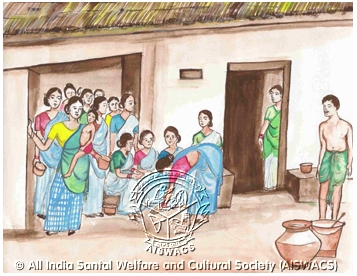 An
elderly person then recites an account of the Creation of
the Universe and Man, the wanderings and the migratory routes
taken by the ancestors and the events leading to the present
settlement in the village. Thus, the initiated one along with
the rest of the villagers are made aware of the Santal tribal
lore and about other santal traditions. No sacrificial offering
are made and the drinking of rice-beer is a witness by the
village folk to have admitted the initiated ones fully into
the society. An
elderly person then recites an account of the Creation of
the Universe and Man, the wanderings and the migratory routes
taken by the ancestors and the events leading to the present
settlement in the village. Thus, the initiated one along with
the rest of the villagers are made aware of the Santal tribal
lore and about other santal traditions. No sacrificial offering
are made and the drinking of rice-beer is a witness by the
village folk to have admitted the initiated ones fully into
the society.
----------------------------------------------------------------------------
BAPLA
(MARRIAGE)
----------------------------------------------------------------------------
Marriage
is the third turning point in the life cycle of the Santals;
it is the most vital event in the life of a santal individual;
this is the reason why the process of contracting a marriage
and associated rites, rituals are complex and time consuming.
Santals are basically monogamous; bigamy is rare and polygamy
unheard of. Normally the marriages are contracted after the
individuals attain adulthood; thus the average age of of marriage
is sixteen for girls and twenty for boys; child mariage among
them is uncommon and are present only in a few localised areas
where the santals have a high degree of interaction with the
non-tribals. The santal couples normally live in the house
of the husband after the mariage - the residence being patrilocal;
however in cases of ghardi jawae or ghar jawae the custom
is reversed - that isthe bridegroom goes and lives in the
brides house. The marriages are strictly contracted within
the santal community; thus, marriages between non - santal
and wihin the same clan is forbidden. There are stringent
customary laws that prohibit such marriages; and if any one
dares to disobey, they are ostracised.
Divorces(
Bapag)
Divorce
among the Santals are not common; however divorces are usually
justified and accomplished in the following cases:-
a)
Adultery committed by either the husband or the wife.
b)
Suspected practice of witch craft by the wife before mariage.
c)
Barreness on the part of the wife and sterility on the part
of the husband.
^TOP^
Sakam
Orec'Ceremony
Just
as there are rituals and ceremonies for contracting a marriage,
divorce is also accomplished through a simple ceremony called
'Sakam orec' (tearing of the leaves).
During the appointed day villagers from the two villages (
that of the boy and the girl) gather in husband's vilage.
The village headman presides over the ceremony. The husband
and wife are made to stand facing each other with a 'lota'
filled with water placed infront of them. The village headman
then addresses the villagers and then invokes the jaher bongas
to be witness to the event. The customary payments are then
made in case the divorce has been agreed upon. The party wiling
to have the divorce then stands on his/her left foot and tears
three sal leaves down the mid rib; after this he/she kicks
the 'lota' dak' by his right foot. Next, the man bows followed
by the women around to the villagers gathered there. This
completes the "Sakam Orec'" ceremony.
Types
of Marriage
Santals
follow several different forms of marriage depending upon
different situations and circumstances. A brief description
of each form is given below :-
1.
Kirin bahu bapla :- In this form of marriage
the bride is brought to the house of the bridegroom after
the father of groom pays the bride-price. This is the most
common form of marriage prevalent among the Santals today.
This is also the most complex form of marriage comprising
of a series of ceremonies and rituals spread over months
together. A detail description has been provided in the
following pages.
2.
Kirin jawae bapla :- When a girl is made pregnant
by a man who simply does not want to marry her or does not
want to marry her because she belongs to the same clan,
a husband is bought or arranged for the girl, the cost being
borne by the offender. This form of marriage, as is evident
is resorted to provide social protection and sanctity to
the pregnant girl.
3.
Tunki Dipil Bapla :- This is a poor man's marriage
undertaken by persons who are not in a position to bear
the expenses of a regular marriage. In this case bride-price
is not paid; the bride simply gathers her few belongings
and puts them into a tunki (bamboo basket) put it upon her
head (dipil) and simply walks down to the grooms house.
4.
Sanga Bapla :- This is a form of marriage contracted
between a widown/divorced woman and a widower/divorced man.
The bride-price in this case is half of the kirin bahu bapla.
^TOP^
5.
Ghardi Jawae and Ghar Jawae Bapla :- In 'ghardi
jawae' bapla the boy(groom) after marriage goes to live
in the girl's (bride) house; this form of marriage is resorted
to by the parents with a number of adult girls with no sons
or minor sons. All the expenses of the marriage are borne
by the girl's side and no bride-price is paid. The groom
works for five years in the in laws household in return
of which he is given food and clothing and a calf during
marriage. In Ghar-Jawae bapla the 'groom' goes to live in
the bride's parents house. A father who has no male offspring
but has only daughters accomplishes this form of marriage.
By this mariage, the girl's parents ensure that their heir
inherits their properties; thus, this marriage requires
formal approval of the girl's relatives and also the consent
of the villagers.
6.
Itut' Bapla:- This is a rare form of marriage
in santal society. The boy having been in love with a girl
forcibly applies 'sindur' (vermillion) on the forehead of
the girl in a market place or any other public place. By
doing this the boy ensures the girl to be his wife and at
the same time overcomes any resistance from her parents'
side.
7.
Nir Bolok Bapla:-
This is also a rare form of marriage wherein a girl having
had a sexual relationship with a boy,forcibly enters the
boys' house(nir bolo), thus forcing the boy to marry her.
^TOP^
The
Santal Marriage - an analytical study
Marriage
in Santal Community is a vital event and is an imporant milestone
in the lifecycle of a Santal individual - the other two important
events being the Birth and the Death. Because of its vital
nature, a series of social ceremonies and rituals are associated
with it; in fact, marriage is the biggest social (ceremony)
event among the Santals. The social ceremonies and rituals
associated with the marriage among the Santals are extemely
intricate and complex. In order to understand and appreciate
these one has to personally witness a marriage ceremony from
beginning to end with a critical mind because all the rituals
and ceremonies have an inner meaning expressing relationship
with their bongas (spirits) and also new social involvement
of the 'couples'. Some of the major social ceremonies and
rituals associated with marriage (Kirin bahu bapla) are described
below:-
Normal
period for marriage
Usually
the marriage ceremonies among Santals are held from March
to June; during this period there is not much of a work to
be done and also there is adequate rice and other materials
available in the households. This period refers to the normal
arranged marriage (Kirin bahu bapla); however exceptions do
exist.
^TOP^
Major
Ceremonies of Marriage :
A
few major customary ceremonies of symbolic significance are
as noted below:
Raebar
(match-making) : Raebar (match-making) is the first step in
the process of kirin bahu bapla; the boys father appoint a
responsible person to look for a bride and a series of discussions
with the perents relatives of either side are made; finally
he fixes the date and venue for the 'nepel' - meaning meeting
each other between the prospective bride and beidegroom along
with their relatives; the venue chosen is normally a public
place - a market place, a fair or sometimes even paddy fields.
This is the first opportunity the boy and the girl along with
a few relatives meets one another. The role of raebaric' in
kirin bahu bapla is very important and hence the marriage
is often called "Raebar Bapla".
Orak'
Duar Nel (inspection of the boys house):
If
during the 'nepel' both the sides agree to the proposal, a
day is fixed for the orak' duar nel - informal inspection
of the boys house by the girl's father along with the village
headman and relatives. On reaching the boy's village, they
proceed to his house accompanied by the Manjhi and Jog manjhi
of that village. After the normal customary greetings of 'abuk
janga' (feet washing) they are given rice beer. However these
drinks are taken only after rice beer libations are offered
by the Manjhi ( of both parties) to the ancestral spirits
of the boy and girl invoking their blessings. The girl's party
thereafter makes a preliminary enquiry from the manjhi and
jog manjhi whether the boy's family has been guilty of any
social offence. They then retire for the night after having
night meals. The following day the girl's relatives are shown
the boy's house and fields; they then decide the gonon or
the bride price.
Horok'
Cikhna (betrothal ceremony)
Traditonally
horok' cikhna' comprise, of two individual ceremonies - the
'Jawae dhuti' and 'Bahu bande'.
^TOP^
Jawae
Dhuti
In
jawae dhuti the bride's father, with uncles, the village headmen,
paranik, jog-manjhi along with the some other relatives and
raebaric' go to the grooms village on a prefixed day. On ther
arrival they are received and accompanied by the village headman
and jog manjhi to the boys house; then they are taken inside
the house after the normal feet washing and anointing in the
courtyard of the groom's house. They are then offered Khajari-gur
(parched rice and molasses) to eat and rice beer to drink.
Then the groom with a lota in hand is brought out of the house
by a married relative usually by his maternal uncle or his
sister's husband to pay respect to the guests. He places the
'lota' infront of the brides's father, sits on his thighs.
He is then offered some rice beer after which he rinses his
mouth. The groom is then offered a new dhoti and some money;
he then kisses him. All other relatives who offer him pieces
of cloth, shirts or money follow the same process. The paranik
then counts the money and the gifts received and annouces
the total amount in public. A goat is then sacrificed by the
jog-manjhi in honour of the family's ancestral spirits and
the jaher bongas invoking them to protect the couple from
all kinds misfortune. The relatives and the villagers then
partake of the sacrificial meals.
Bahu
Bande
A
similar betrothal ceremony is performed in the bride's house
by the grooms party; various gifts are offered to the bride
by the grooms party. Bahu bande is often set aside if the
marriage is to be performed early. These betrothal ceremonies
signify the ratification of a contract between the two parties
- the-would be bride's and groom's families; the gifts made
during these ceremonies are regarded as the seals and testimonies.
By this contract, the boy or the girl are prevented from running
away and entering into any marriage, without the consent of
both the families - in which case the gifts are to be returned.
This is the reason the gifts are counted during the betrothal
ceremony.
^TOP^
Taka
cal and Gira Tol
The
'Taka cal' (paying the bride's price) ceremony is held in
the bride's house. The grooms' father accompanied by the village
headman, jog manjhi and a few relatives go to the bride's
house. On their arrival at the bride's house they are offered
rice-beer after the usual salutations and welcome ceremonies;
the bride's price is then decided upon and paid off; this
is supposed to be the proof of legal possession. All those
present, then decide upon the actual date of marriage - the
process being called the Gira tol . At the end, meal is offered
to everyone present after the usual invocation of the ancestral
spirits for the well being of the perspective husband and
wife.
Mandwa
(Marriage shed)
Mandwa
- the marriage shed is usually set up two or three days before
the marriage in the bride's and the groom's house. Before
the mandwa is set up the brided's father gives three fowls,
a pot of rice beer and some rice to the village-priest which
he offers to the Maran buru, Jaher Era and More-ko-turuiko;
during the sacrifice the priests invokes these bongas to ward
off any evil spirits and keep the village clean during the
marriage. The jog manjhi and jog paranik then asks the villagers
to set up the mandwa. The central post of the mandwa called
mandwa khunti is usually of the mahua branch with the canopy
of the shed sonsists of twings and small branches of mango,
sal and mahua trees.
^TOP^
Dak'bapla
(water marriage ceremony)
The
Dak' Bapla - ceremony is held one day before the groom along
with his party (bariat ko) set forth to the bride's house.
The ceremony starts with the anointing (sunum sasan) of the
village folk gathered under the mandwa by the tetre kuri;
the village headman and his wives are first to be annointed
while the groom's parents are annointed last. After this,
the jog manjhi with a lota of rice beer, the tetre kuri carrying
two earthen pots sagun thilli (ominous pots) on head convered
with yellow cloth (sasan kicric), the grooms mother carrying
adwa caole, oil, vermillion, dhubi ghas and three cowrie shells
and two paternal aunts carrying a sword and a bow and arrows
then proceed to fetch the ceremonial water. They are all accompanied
by village girls dancing (dak' bapla don) to the beating of
dhols and rahar by the doms. Once at the pre-arranged spot,
the babre-kora digs a hole at the waterside and allows the
water to seep through. The jog majhi then plants three arrows
around the hole and winds a thread five times around these
arows; covers the cowrie shells with sindur after which Daramdak'
(Welcome ceremony)
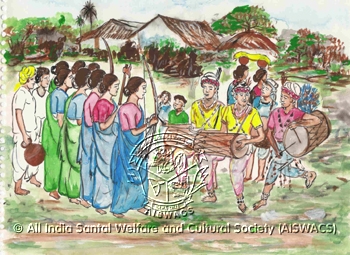 Bariatko
(groom's party) proceed, towards the bride's house amidst
the beating of dhols and rahar; raebaric's wife carries a
big basket - daura' and the 'groom' and lomta kora are carried
on a rahi or palanquin. On reaching the bride's village, the
bariatko initially camp at the west side of the kulhi; the
raebaric' (matchmaker) then informs the bride's party of their
arrival. The bride's party along with the raebaric', godet
and jogmanjhi of the village then bring the groom's party
to the majhithan. Here two pigeons are sacrificed to the Manjhiharam
and Jaherbongas; rice beer libations are also offered. After
this the bride's mother offers molasses and water to the groom
and lomta kora; the close relatives of the bride repeat the
process. This completes the welcome ceremony. Bariatko
(groom's party) proceed, towards the bride's house amidst
the beating of dhols and rahar; raebaric's wife carries a
big basket - daura' and the 'groom' and lomta kora are carried
on a rahi or palanquin. On reaching the bride's village, the
bariatko initially camp at the west side of the kulhi; the
raebaric' (matchmaker) then informs the bride's party of their
arrival. The bride's party along with the raebaric', godet
and jogmanjhi of the village then bring the groom's party
to the majhithan. Here two pigeons are sacrificed to the Manjhiharam
and Jaherbongas; rice beer libations are also offered. After
this the bride's mother offers molasses and water to the groom
and lomta kora; the close relatives of the bride repeat the
process. This completes the welcome ceremony.
^TOP^
Balaea
Johar (Salutation ceremony)
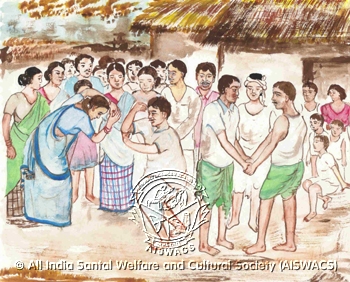 After
the welcome remony, the relatives belonging to the bride and
the groom's family stand in two lines face to face. Then the
grooms relative start saluting the bride's relative - the
groom's father leads, followed by the male members and ultimately
the female members follow. This process signifies the new
bond and relationship being entered into through the marriage. After
the welcome remony, the relatives belonging to the bride and
the groom's family stand in two lines face to face. Then the
grooms relative start saluting the bride's relative - the
groom's father leads, followed by the male members and ultimately
the female members follow. This process signifies the new
bond and relationship being entered into through the marriage.
Gurjom
( eating of the molasses ceremony)
After
the Balaea Johar, the gurjom ceremony is performed. This comprises
of visits to all the households in the village by the groom
and lomta kora where they are given molasses to eat and water
to drink. The process strengthens the bond between the groom
and the bride's villagers.
Sara
Darhi
The
groom on arriving at the bride's house is washed, anointed
with oil and turmeric and dressed in saffron clothes. He is
then lifted on the shoulder of his babre kora; similarly the
bride's younger brother is lifted on the shoulder of his brother-in-law,
both facing each other with a piece of white cloth separating
them. Then they sprinkle water over each other five times
by dripping the mango twig with five leaves in a 'lota' of
water. Then they blow chewed rice over each other. After this,
the bride's brother offers a saffron turban (Sara arhi) to
the groom.
This ceremony is accompanied with a mock fight (paikaha/Natwa
don) between the boys' and girls' party outside to the beating
of the 'dhols' and 'rahar'.
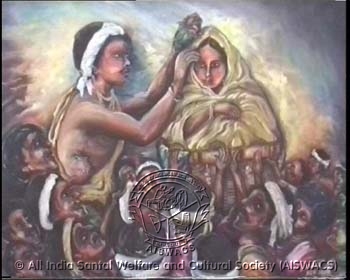
SINDRADAN
(Smearing of bride's forehead with vermilion)
This
is the essence and the most fundamental of all marriage ceremonies.
The bride is anointed with oil and turmeric and is dressed
with saffron clothes covering her wholeface. A few members
of the groom's party then enter the house, put her in the
daura - (large bamboo basket) and bring her out. The groom
is lifted over the shoulder of the babre-kora and faces East,
opposite to the bride. Both, the bride and the groom sprinkle
water over each other five times by a mango twig with five
leaves being dipped everytime in a lota of water.Then
the groom uncovers the face of the bride and applies vermillion
from a leaf cup five times using his right thumb and little
finger. The remaining vermilion is then smeared on theside
of the bride's neck. The empty leaf-cup is then handed over
to the babre-kora who ties it to the cloth of the groom. The
Sindradan is accompanied by the beating of dhols and rahar.
One of the material aunts then ties the ends of the cloths
of the newly weds signifying that henceforth they are one
and united.
^TOP^
Cumaura and Parchau (Waving and Purification
Ceremony)
These
two ceremonies are performed after the sindradan before the
new couples are allowed to enter the bride's house. In the
cumaura ceremony the bride's mother carries a winnowing fan
(hatak') containing some adwa caole. dhubi ghas and horo.
She waves the hatak' three times over the couples and lumtikora,
lumtikuri and the babrekora each time scattering the contents
of the hatak' at their backs. Other close relatives of the
bride repeat the process. After the cumaura, parchau ceremony
is performed. In this two maternal aunts of the bride come
out of the house carrying two brass plates, one plate containing
four leaf-cups - two filled with oil and two with molasses;
the seccond plate contains two leaf cups of turmeric and five
flour balls. The bride's mother anoints the couples and gives
them molasses to eat and water to drink; then smears their
faces with turmeric too. Then the bride's mother takes the
five balls of cowdung and flour and scatters them over their
heads. A few close relatives of the bride also repeat the
ceremony. After this ceremony the couples are led into the
house and served with food.
^TOP^
Gidi
Cumaura (Second waving ceremony)
The
couples along with their companions and the relatives as also
the villagers gather next morning under the marriage shed.
A mat is spread and the couples sit - the bride sitting on
the left side of the groom. On the left side of the bride
sit the lumti kuri and babre kuri while on the right side
of the groom sit the lomta kora and babre kora. The couples
are then anointed and taken round the mandwa khunti thrice.
Then bride's mohter then comes with the daura containing some
dhubi ghas and adwa caole; she then waves the daura three
times over each one's head and scatters some dhubi ghas and
adwa caole over their heads. After that she puts some money
in the brass plates kept infront of each of them. The relatives
and wives of the village officials repeat the process. The
last to perform the ceremonies are the elder sister and cousins
of the bride. All of them then go to the Manjhithan where
the Jog Manjhi offers rice-beer libations to the Manjhi haram
bonga implouring him to protect the couples during their return
journey and also in the days to come. After this all the villagers
and relatives go to the eastern end of the village where the
farewell ceremony is to be performed. As usual, a mat is spread
out and the bride's mother gives the groom molasses to eat
and wate to drink; after this she kisses him. She does the
same to the bride. Then the villagers stand on two lines facing
each other to perfom the Balaea-Johar ( farewell salutations);
after this farewell addresses are delivered by the jog-manjhi
of the groom's village and by the bride's headman. The speeches
highlight and stress upon the new social relationship entered
into by two individuals as also by the members of the two
villages. That the marriage is a union of two villages as
much as a union of two individuals is indicated in the parting
speech, which says thus:
.......from
today our two villages have become as one ..... Formerly you
were strangers and you used to pass by our village. Now if
any of your people is passing this way.... he must stop and
ask for a drink. After the parting ceremony the jog manjhi
of the bride's village hand her over to the groom's headman;
then the couples along with a few male and female members
(lunti-baret) proceed to the groom's village. One of the groom's
party also carries the mandwa khunti with them.
On
reaching the groom's village the welcome ceremony (Daramdak'),
the gurjom ceremony cumaura and parchau ceremonies are performed
as in the bride's house. After one or two days the bride's
brother is given a cow or a goat (bare-itat') to take home.
The couples again return to the bride's house after three
days. Here bride's father offers a goat honouring the ancestor
spirits; rice-beer libations are also made imploring the protection
of the ancestor spirits. All present partake of this food
except the bride.
^TOP^
----------------------------------------------------------------------------
D
E A T H
----------------------------------------------------------------------------
Traditional
Beliefs
Death
is the final stage in the life-cycle of a Santal. However
Santals do not believe it to be the end of the social person;
but death to them is a stage of transformation. Traditionally,
Santals believe in two worlds - noapuri (this visible world)
and hanapuri (world after death). Death is the bridge leading
to hanapuri. Santals believe that after death, the departed
joius his ancestors and is transformed into hapram bonga (ancestors
sprit). Their belief in hanapuri and the transformation into
hapram bonga can be easily gauged from the terms usually used
for their dead ones like - bonga talaenae (he has become one
with the sprit) or nitok' doe hapramena (now he has become
sprit). The Santals further believe that good people would
be rewarded and the wicked punished in the hanapuri - thus
they believe in jom raja and hudur raja awaiting the wicked
ones in hanapuri to punish them.
According
to traditional beliefs the departed ones can not join their
ancestral spirits (bongas) in hanapuri unless certain death
ceremonies and rituals are accomplished. Santals believe that,
death pollutes the household of the deceased and also the
village; thus the baihar bongas and the jaher bongas are polluted;
this is so becouse death is a victory of maligant ones over
the benevolent bongas concerned with the well being of the
individuals and the village. Hence, no social ceremonies like
marriages or agricultural festivals like Baha, Sorhae can
be performed unless purificatory ceremonies have been performed.
The
Mourning and Burial
The
death of a person in a household is an occassion of mourning;
the news of the death is passed on to the villagers by the
godet. The dead body is prepared for burial by dressing it
with new cloths and putting it on a stringed cot (parkom)
which is brought to the courtyard. A plate and driking vessel
made of brass is placed on the cot. Some money tied in a piece
of cloth along with other gifts are given by the relatives
as token of mourning. The body is also anointed with oil and
turmeric.
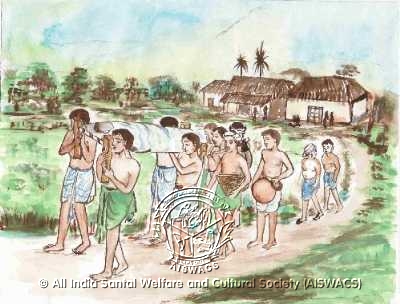 The
body thus prepared is then taken to the burial place in the
outskirts of the village; the grave is usually dug in a North
- South direction. On reaching the grave all the gift items
along with the brass vessels and money are removed; they are
later used for procuring handi - paura (rice beer and liquour).
A piece of cloth is then laid inside the grave, the body is
taken round three times arround the grave and then a glowings
ember is put inside the mouth of the body by the chief mourner.
Then the body is lowered inside the grave with head facing
south. A canopy of branches is made over the body and the
cot is then broken with the bamboos placed over the canopy.
The chief mourner puts the first soil inside the grave followed
by other relatives until the grave is filled by soil. A winnowing
fan with some paddy is left behind. The villagers then go
for a purificatory bath and then they anoint them selves with
sunum sasan. The chief mourner head is totally shaved. Then
they return to the village. The
body thus prepared is then taken to the burial place in the
outskirts of the village; the grave is usually dug in a North
- South direction. On reaching the grave all the gift items
along with the brass vessels and money are removed; they are
later used for procuring handi - paura (rice beer and liquour).
A piece of cloth is then laid inside the grave, the body is
taken round three times arround the grave and then a glowings
ember is put inside the mouth of the body by the chief mourner.
Then the body is lowered inside the grave with head facing
south. A canopy of branches is made over the body and the
cot is then broken with the bamboos placed over the canopy.
The chief mourner puts the first soil inside the grave followed
by other relatives until the grave is filled by soil. A winnowing
fan with some paddy is left behind. The villagers then go
for a purificatory bath and then they anoint them selves with
sunum sasan. The chief mourner head is totally shaved. Then
they return to the village.
^TOP^
Umul
Ader / Tel Nahan ceremony
The
ceremony is performed normally on the 5th day of the death
of a person. Traditionally it is believed that the death defiles
the household and the village and so no social ceremonies
or functions can be held in the village until Umul Ader has
been performed. Thus the ceremony is performed for two specific
reasons :-
a)
To release the dead person now in the form of shadow (umul)
from the clutches of evil powers(malevolent sprits)
b)
To purify the household and the village from the defilements
brought about by the death of the person.
The
ceremony has two parts :-
a) Purificatory : On
the day of the ceremony the villagers along with the relatives
gather at the deceased persons house from where they go
to the grave. Here the chief mourner takes a handfull of
soil and puts into a new earthen pot after burring them.
While returning to the village they are met by women folk
at the end of the village kulhi here the pot is smashed
and the contents are sprinkled with water and turmeric.
Then the chief mourner collects some burnt soil and carries
it on a leaf plate and proceeds for purificatory bath along
with others. After the bath, the chief mourner offers 'sal
twigs' and oil cakes to the Maran Buru, Pilcu Haram and
Pilcu Budhi and implores the Maran Buru to keep the deceased
soul in the sadow of the house.
b) After the purificatory bath they return to the house
of the deceased. Here two persons become possessed one by
spirits of Maran Buru and the other by the sprit the deceased.
The decesed spirits is then asked the reason of his departure
to hana puri - whether it was by his free will or whether
it has been one to illness or hostility. On getting sutible
replies the two persons again continue their usual duties.
The chief mourner then offers the sacrificial animals to
the deceased spirit; the relatives and the villagers also
offer fowls to the deceased spirit; the sacrificial animals
are killed with blows on the back (kutam) and not by beheading
them. All those gathered then have rice beers and partake
of the sacrificial meals. They then return to their house.
The completion of the umul ader ceremony results in the
release of the decease person from the clutches of the evil
sprit but is still to be admitted into the kingdom of hapramko
(ancestors). In a way, the spirit has not reached his final
abode but is still in his journey.
^TOP^
Bhandan
The
bhandan ceremoney is the final death ceremony that is meant
to achieve :-
a)
The total purification of the household and the village.
b) Enables the deceased to reach his final abode in hanapuri
Bhandan
is normally performed at the discretion of the deceased person's
household depending upon his financial ability. On the prefixed
day, the villagers and the relatives gather in the deceased
persons household; the chief mourner shaves his head and others
shave their beards. They then have the usual purificatory
baths. After their return they eat taben khajari in the household;
the spirits of the deceased, the founder of the village and
Maran Buru then possess three persons, once again the deceased
person is asked the cause of his death. On getting a positive
reply they again resume their normal functions.The sacrificial
offering (goat) is made by the chief mourns at the courtyard
on a khond. The goat is usually killed by the Jog-Manjhi by
a hit with the butt end of axe. This sacrificial offering
is made to the spirit of the dead person 'who' is invoked
to protect all his living relatives and keep away evil sprits
from them. The villagers and other relatives attending the
Bhandan ceremony also make offering of fowls to the dead persons
spirits. This is followed with rice-beer libations.
The sacrificial meat is then dressed and cooked with rice
(sura daka); the chief mourner then offers some of this sura
to the sprit of the dead person invoking him to accept the
food and totaly clean the householod from all the impurities.
Then all the relatives and villagers partake of the sacrificial
sura. The people then dance and sing whole night. After this
all the person disperse. Through this ceremony the household
and the village becomes completely free from all impurities
and can thus receive the blessing of the benevolent spirits.
^TOP^
|



 AISWACS
 Santal
Hul - 150
Santal
Hul - 150