LANGUAGE
- A VEHICLE OF CULTURE
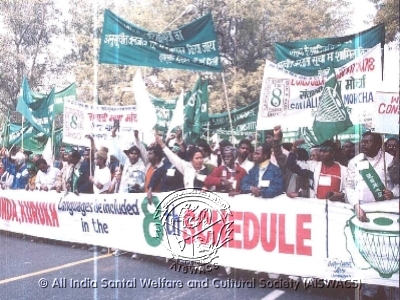 Language
is the vehicle of any culture and culture is the lifeline
for sublimity of any society. Nothing could be said for sure
as to how language came into existence Possibly this is in
existence since man arrived on the face of the earth It is
therefore as old as the human species. Most human activity
depends upon involvement of more than one person. A common
language enables human beings to work together in an infinite
variety of ways. Language has made development of all human
activity possible and so is the development of science, religion,
commerce, governance, art, literature and philosophy. The
language learning process is deliberate and conscious which
includes sound pattern, words and grammatical structures.
The people of India speak many languages and dialects which
mostly are varieties of about 14 principal languages. There
is a wide variance in the number of people speaking each language.
Again some of the languages are called "tribal"
or "aboriginal" but the number of persons who use
them may be larger than those that speak some of the European
languages. Indian schools teach 58 different languages. The
country has newspapers in 87 languages, 71 radio programs
and films in 15 languages. The Indian languages belong to
four language families; Indo-European, Dravidian, Mon-Khmer
and Sino-Tibetan. Indo-European and Dravidian languages are
used by a large majority of India's population. The language
family divide roughly into geographic groups. In the northern
and central India the Indo -European group of languages is
spoken mainly while in the Southern India the Dravidian group
of language is spoken. Some ethnic groups in Assam and other
parts of eastern India speak languages of Mon-Khmer group.
People of the northern Himalayan region and near the Burmese
border speak Sino Tibetan languages. Speakers of 54 different
languages of the Indo-European family make up about three-quarters
of India's population. Twenty Dravidian languages are spoken
by nearly a quarter of the people. Speaker of Mon-Khmer languages
and 98 Sino -Tibetan languages together make up about 2 percent
of the population. The changes in and the development of most
of the Indian languages is a continuous process and introduction
of new words is an ongoing system of development where adoption
of foreign vocabulary from another Indian language is not
shied off. While the above jugglery of statistics is of academic
importance the language spoken by 8.29% of Indian population
is of endemic importance. Of this the most researched is the
Mundari group of languages spoken by the Santals of Jharkhand
and its nearby areas.It was the missionaries who started writing their language
at first with the Bengali script followed by Roman Script
aided with some diacritical marks. It is said that the Santals
are more tenacious of their language than many of other tribes
to whom they are racially allied. Thousands years of foreign
aggression on this land has not corrupted their language.
Troisi has complemented this when he said" They have
managed to keep their language in so far as their grammar
and the agglutinating principle is concerned, astonishingly
free from foreign influence. Their vocabulary, however, has
met with a different fate. A lot of words from other languages
have been adopted and adapted to Santal ideas and linguistic
rules"
Language
is the vehicle of any culture and culture is the lifeline
for sublimity of any society. Nothing could be said for sure
as to how language came into existence Possibly this is in
existence since man arrived on the face of the earth It is
therefore as old as the human species. Most human activity
depends upon involvement of more than one person. A common
language enables human beings to work together in an infinite
variety of ways. Language has made development of all human
activity possible and so is the development of science, religion,
commerce, governance, art, literature and philosophy. The
language learning process is deliberate and conscious which
includes sound pattern, words and grammatical structures.
The people of India speak many languages and dialects which
mostly are varieties of about 14 principal languages. There
is a wide variance in the number of people speaking each language.
Again some of the languages are called "tribal"
or "aboriginal" but the number of persons who use
them may be larger than those that speak some of the European
languages. Indian schools teach 58 different languages. The
country has newspapers in 87 languages, 71 radio programs
and films in 15 languages. The Indian languages belong to
four language families; Indo-European, Dravidian, Mon-Khmer
and Sino-Tibetan. Indo-European and Dravidian languages are
used by a large majority of India's population. The language
family divide roughly into geographic groups. In the northern
and central India the Indo -European group of languages is
spoken mainly while in the Southern India the Dravidian group
of language is spoken. Some ethnic groups in Assam and other
parts of eastern India speak languages of Mon-Khmer group.
People of the northern Himalayan region and near the Burmese
border speak Sino Tibetan languages. Speakers of 54 different
languages of the Indo-European family make up about three-quarters
of India's population. Twenty Dravidian languages are spoken
by nearly a quarter of the people. Speaker of Mon-Khmer languages
and 98 Sino -Tibetan languages together make up about 2 percent
of the population. The changes in and the development of most
of the Indian languages is a continuous process and introduction
of new words is an ongoing system of development where adoption
of foreign vocabulary from another Indian language is not
shied off. While the above jugglery of statistics is of academic
importance the language spoken by 8.29% of Indian population
is of endemic importance. Of this the most researched is the
Mundari group of languages spoken by the Santals of Jharkhand
and its nearby areas.It was the missionaries who started writing their language
at first with the Bengali script followed by Roman Script
aided with some diacritical marks. It is said that the Santals
are more tenacious of their language than many of other tribes
to whom they are racially allied. Thousands years of foreign
aggression on this land has not corrupted their language.
Troisi has complemented this when he said" They have
managed to keep their language in so far as their grammar
and the agglutinating principle is concerned, astonishingly
free from foreign influence. Their vocabulary, however, has
met with a different fate. A lot of words from other languages
have been adopted and adapted to Santal ideas and linguistic
rules"
 ^TOP^
BOTTOM
^TOP^
BOTTOM
CAUSES
OF LAGGING BEHIND OF SNATALI LANGUAGE
The
Cause as to why it was left out
Cultural, ethnic, linguistic and religious factors are the
ingredients and material for a common bondage for the building
of a society. These are sources of solidarity and catalytic
agents for the development. India being a country of diversity,
the recognition and fostering of different identities by the
ruling sectors and by the indigenous elite with perpetual
similar school of thought, ethnicity serves as an element
of support for hegemony of dominant classes and of the State.
This also contributes to form strategies, policies and the
continuance of the class domination. Researchers feel that
diversity becomes particularly "subversive" in the
realm of culture where the resilience of indigenous styles
demonstrates the limits of hegemonic forces. As a result thereof
in a number of multi-ethnic societies, the language of indigenous
inhabitants and ethnic minorities are marginalised or their
existence is denied at the expense of forcing the language
of these in power as the official one. The reasons are understandable
in the context of the fact that while the language of the
neighbors of the Santals continued to make progresses the
language was left defined as alien and the one spoken by the
"primitive man". As a result thereof, the rich language
with a emotive linkage with large populace was apathetically
left to the mercy of history for obvious political reasons
after independence and prior to that period it was the continuous
brush with the authorities to retain their ethnicity which
had frozen it in the embryo stage for a painfully long period.
Indians, as a people, are immune to the presence of our aboriginal
population as forming an element distinct from the ordinary
body politic.
As
a contribution of the British psyche, the present day Indians
have a tendency to look upon the Indigenous people particularly
living in isolation and self contained communities as a
distinct group both culturally as well as ethnically. They
are looked upon as lesser human beings in the Indian notion
of caste. This has affected the man to man relation and
aboriginal continued to be a subject matter of anthropological
dissection. On the other way around, development is a two
way process and not all the responsibility can be bestowed
on the State to uplift and make available the gains of development
to every individual people unless they are receptive and
make sincere efforts to buy mileage out of the developmental
cycle. Here the concept of ethnicity as nurtured by the
Santal psyche played truant. They are at times irrationally
alarmed to judge that at any new whiff of fresh air to be
harmful to their culture and as such is best abhorred. The
language as also the people had therefore had a long and
lonely journey down the lanes of history where destiny played
a decisive role. Truly this again is a santali trait.
^TOP^
BOTTOM
SANTALI
- The Language of Santals
The
Santals are great storytellers. The Santal folktales are symbolic
of their character, traditions, religious beliefs and social
customs. In the daily life of a Santal the folklore, riddles,
and puzzles have very important role. After nightfall, the
children gather round the grandmother or the grandfather and
hear the oft-repeated folk stories. Similarly, in the grazing
grounds, the Santal boys sit together and one of them recite
one story and then another does the same. The young girls
assemble for some festival in a santal house and one of them
refers to a story and the others will ask her to recite the
tale. In this way from generation to generation folk stories
of the santals have been repeated and are preserved. The folktales
cut across the barriers of the provinces and it is strange
that some of them one could hear in Assam or in Kerala. The
stories give Santals a feeling of self-confidence in his relations
with the outside world. Therefore in most of stories the weak
triumph over the strong. The youngest son or daughter prospers,
the eldest son passes his life by shouldering responsibilities
alone while his wife suffers. The poor little sister of the
household with the help of frogs and snakes manages to accomplish
the task set by her jealous sister in law. The simple outwits
the clever. The poor prosper and the wealthy lose their reaches.
Interestingly, animals account for a large number of stories
where they adopt the role of clever men, jealous wife or a
lovelorn suitor to compare with the basic human instincts.
The language of such a massive strength was however limited
to the spoken world. The study of their language as an element
of expression of their culture was done for the anthropological
interests alone. People of other castes pick up their language
only to be accessible to them in business matters for the
barter of goods or for employing them as agricultural or farm
labourers. Further, as a two way channel the adivasis also
found it beneficial to know the language of their cultivating
neighbourers. However all these were temporary phases for
limited transactions and were blissfully forgotten with the
passage of time. Fortunately therefore the Santals maintained
the century old traditions of story telling for the bulk of
their cultural inputs continued to be transmitted so for generations.
The
real documentation of the Santali language came into being
in the early nineteenth century. Till that time it was a
matter of great surprise as to how a homogenous group of
people who jealously guard the flavour of earthly culture
could afford to do without a script of their own. The Santals
speak an independent language known as Santali. It belongs
to the Munda family of languages, which Peter W.Schmidt
classified as belonging to the Austro-Asiatic language group.
Santali is the most important of all the Munda group of
languages. Correrson has characterized it as a remarkably
uniform language. Its grammar developed by Skrefsrud was
published in 1873 and this is till the leading authority
and is unsurpassed in correctness and consistent orthography.
The Santals are the largest tribe in India to retain an
aboriginal language to the present day. They have to alarge extent adopted the Roman
Script, using certain diacritical marks to denote sounds
differing from those which those letters have in English.
It is tragical that the Santals who are the most researched
had no records of their own. The records were initiated
on their behalf by the ethnographic accounts collected by
travelers, missionaries and British administrators. E. G.
Mann who was an Assistant Commissioner in the newly formed
district of Santal Paraganas titled the first book on Santals
published in 1867. Carstairs, L.S.S.O'Malley, Hunter and
Archer, which contain good accounts of the Santals, their
land, customs and habits, followed this. But the Christian
missionaries, who had left invaluable data on the Santals
and were the first to initiate an interest in the Santal
Language and culture, made the greatest impact.
^TOP^
BOTTOM
THE LOOK FOR REMEDIES & RECOMMENDATIONS
The
question as to why the Santals could not develop their own
language has long been researched. In the earlier times
anthropologists usually perceived tribes as territorial
groups adhereing to oral traditions that is, groups that
do not have scripts or written texts. The constant intermingling
with other cultures not only resulted in the encroachments
into the erstwhile territories of the tribes as there is
not only encroachments into the erstwhile territories of
the tribes, but there is much more of the creation of sectors
for interaction, intermingling and exchange between tribes
and others. The Santals have
been persistenent and made sustained attempt to create and
revive a script for this language that is called Olciki.
This is almost a singular example of a tribe claiming to
have a script of their own primarily because of their large
numbers, the significance of their participation in polity
and their very rich linguistic and literary heritage. (
Bhattacharya/2003/Tribes in India ; Process of Transition
) The Santals are painfully resigned to the fact that their
fate have been subjected to age old tendencies of manipulations
and so is their language. But it eventually contributed
to the efforts in crystallization of the ' identity' from
the perspective of the mainstream in which they have been
helped by the serious inrests of the missionaries, scholars
and administrators in exploring the depths of Santali language.
They understand well that unless a political commitment
asserts itself they would continue to be at the mercy of
the alien culture and language. They feel to have been slighted
for no rhyme or reason. However, owing to their subtle tendency
of being outwardly looking and a deadly positive guided
by an orthodox attitude, they have enormous expectations
from the new set up of having a separate and independent
state. This has, for the present, attributed them with some
identity and they on their part have reciprocated with attaching
a sense of belonging to the change. A spirit of impatience
however is apparent, as the populace having long been put
to neglect desires results instantly. However, the concept
is not altogether misplaced. Change in the present political
scenario in the country takes time. However, this can be
hastened if priorities are deciphered intelligently. Reasonably
the following areas needs effective intervention :
(a)
There is an urgent need to look for primary teachers from
the local populace who can undertake their jobs with a sense
of devotion. Existing teachers are required to be trained
in the local language so that they can efficiently impart
education. There is also a need to train the parents of
the school going children to provide adequate infrastructural
support to the children in their studies at home. The parents
need to be persuaded on ensuring that they send their wards
to schools regularly and there is need for interaction between
the parents and the teachers at regular intervals.
(b)
OL -CHIKI script invented by Pandit Raghunath Murmu is becoming
popular day by day among Santals for its emotional reasons.
However, 'Roman', ' Devnagri' and 'Bengali' scripts continue
to be in use till a greater consensus emerges.
(c)
Effects of education and the benefits thereof are communicated
by undertaking wide publicity campaigns and for that matter
help of NGOs in conducting seminars be obtained.
(d)
In the regional language text books as contained in the
curriculum; the teacher should know the tribal language
and should be able to explain the contents of the text books in the
local languages.
(g)
The gloriuos history of Santals are important for inclusion
in the text books but alongside the history of the country
should be put in proper perspective and be disseminated
with the same amount of pride that is attached to the tribal
history. A strong and persuasive attitude should be adopted
in teaching arithmetic so that the benefits of the subject
are adopted at ease in the daily life.
(h)
A serious and practical approach may be undertaken so that
the local language could be adopted for all government matters
especially when the government interacts with the members
of the public. Higher echelons of the bureaucracy are required
to be trained appropriately to transact their daily businesses
in the local languages. In the initial stages the Government
may publish a periodical journal in the local language to
update the masses about the developmental activities undertaken.
A close watch may be kept on conduits and to the extent
possible, all activities of the Government be entrusted
to the locals so that the sense of belonging with the masses
is maintained.
(i) A comprehensive and practicable approach be undertaken
so as to make available the benefits of the judiciary to
the masses so that the handicap of the language does not
deter them from approaching and appreciating the systematic
and time tested judicial system.
(j) The progress achieved by other sister states in the
country in various developmental activities be conveyed
so that a more systematic and purposeful lifestyle becomes
a tendency with the masses.
(k) A scientific approach and benefits of perspective planning
in all stages of life be explained through short films,
light literature and in the form of anecdotes.
^TOP^



 AISWACS
 Santal
Hul - 150
Santal
Hul - 150