I.
Festivals and Religious Rites
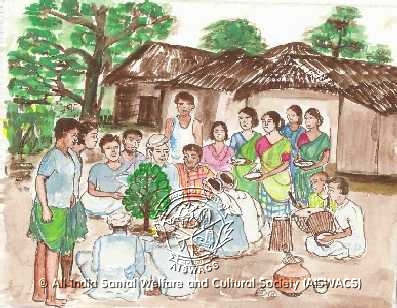 'Rites'
refers to a set of prescribed form of religious activities
having reference to beliefs in invisible sprits and their
powers. Rites usually consist of `Dare' (Sacrifcial offerings),
Codor (libations) and bakher (invocations). Festival on
the other hand refers to a community celebrations which
is a combination of socio-religious and the secular activities.
The religious aspects Comprise of performing various prescribed
rites for a particular festival (seasonal or otherwise);
This is followed by a Community celebration where all the
members-boys and girls young and old dance and sing, eat
and drink thus participating in the merry making.
'Rites'
refers to a set of prescribed form of religious activities
having reference to beliefs in invisible sprits and their
powers. Rites usually consist of `Dare' (Sacrifcial offerings),
Codor (libations) and bakher (invocations). Festival on
the other hand refers to a community celebrations which
is a combination of socio-religious and the secular activities.
The religious aspects Comprise of performing various prescribed
rites for a particular festival (seasonal or otherwise);
This is followed by a Community celebration where all the
members-boys and girls young and old dance and sing, eat
and drink thus participating in the merry making.
The Santals are a joyous community; 'raska' meaning pleasure
or joy is their motto in life; they are happy and contented
even in the worst situations of ulter poverty. Thus there
are numerous seasonal rites and festivals celebrated by
the Santals. Their behaviour during these festivals are
characterised by a carefree, unhibited attitude and a joyous
frame of mind. Men and women, adults and children all gather
together for the occassion to indulge and to meet their
friends and relatives. Dancing and singing hold very important
roles in almost all these festive occassions.
----------------------------------------------------------------------------
II. Major Seasonal festivals of
the Santals
The following table shows the annual cycle of the Santal
festivals and their relationship with various agricultural
activities.
Festival Month Agricultural Operation
Baha Phagun (February-March) Offering of the 'first fruits'
of matkom and other wild fruits and flowers.
Erok'
Sim Asar (June - July) Sowing of rice seeds.
Hariar
Sim San (July - August) Sprouting of the rice seeds.
Iri-Gundli
Nawai Bhador (August-September) Offering of the first fruits
of the millet crops
Janthar
Aghar (November-December) Offering of the first fruits of
the winter rice crop.
Sohrae
Pus (December-January) After the paddy has been harvested.
Magh
Sim Magh (January-February) Cutting of the thatching grass.
 ^TOP^
BOTTOM
^TOP^
BOTTOM
----------------------------------------------------------------------------SOHRAE
(harvesting festival)
Sohrae is the principal and the most important public event
of the Santals; it is also the largest of the festivals.
Sohrae is usually celebrated in the month of Pous (December-January)
when the paddy has been reaped, thrashed and stored.
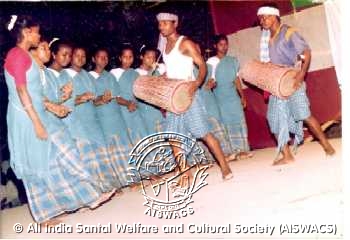
It
is a post harvest festival, celebrated for five to six days
in winterDuring the Sohrae the village spirits and the ancestor
spirits are worshipped and thanked; the rituals include
sacrificing. The six daysof festivities have each day earmarked
for special activities. The important and the usual components
of Sohrae festival include blessing and baiting of cattle
(gai-dangra sunum ojok'ar charhao) fishing expedition (hako-katkom)
and a village hunt (sendra). Sohrae is the biggest annual
event for the Santals to relax and enjoy. During this period
the married daughters return to their houses and relatives
from other villages also come with gifts. It is the biggest
community celebration during which the whole community eats
and drinks , dance and sing and make merry.
This is the occasion for the great communion whereby the
whole villagers with their relatives along with the ancestors
and the spirits come together to join in the merriest of
festivities.
Baha
- (the flowering festival)
Baha porob - the festival of flowers is the second largest
festival of the Santals being celebrated in the month of
phagun (February-March) after the full moon has been sighted.This
is also the period when the sarjom(sal) and the matkom (mahua)
trees blossom. Before Baha festival, no one is allowed to
gather the matkom baha which provide the Santals with food
and drink. The celebration usually lasts for two days. Baha
is a "righteous festival and not licentious like the
sohrae" remarks Kolean (Bodding 1942:151).
Baha is considered to be the beginning of the Santal year;
the rituals comprise of massive propitiation of the national
spirits who are invoked to keep the villages free from various
illness and witchcraft and preserve the crops.
The Baha porob is celebrated in different days in different
villages; thus the villagers have adequate opportunities
to visit their relatives and join in the feast of eating,
drinking and dancing.
^TOP^
BOTTOM
Erok'
Sim (sowing festival)
Erok' sim is yet another of the agricultural festivals.
It is celebrated in the month of Asar (June-July) just before
the winter paddy is sown. The village council decides upon
the day of the celebration. On the forenoon of day of the
festival, the godet visits each household in the village
collecting fowls (sim) and other materials for the sacrificial
offering. Then in the afternoon the naeke after the usual
purificatory bath goes to the jaherthan being accompanied
by the Kudam naeke, the godet and some villagers. The naeke
sacrifices the fowls one each to propitiate the Maran Buru,
moreko-turuiko, Jaher Era and Gosae Era. Another fowl is
sacrificed in honour of Manjhi Haram. The Kudam naeke then
offers two black fowls - one each in honour of Sima bongas
and Bahre bongas. The spirits through these sacrifices are
implored to keep the village free from diseases and to bring
rain and festivity to the land, thus enabling them to have
a bumper crop. The spirits are also implored to keep the
cattle healthy and enable them to increase in number.
After
the sacrificial offering, the fowls are cooked with rice
and all the people present eat of the sura-jel; however
it is noteworthy, the fowls sacrificed to Jaher Era and
Moreko-Turuiko are cooked separately and eaten only by the
naeke. After this ceremony, the villagers sing and dance
in the kulhi. The following day each household in the village
sacrifice fowls in honour of Maran Buru, abge bongas and
orak' bongas. After the completion of this festival the
sowing of the winter paddy begins.
^TOP^
BOTTOM
Hariar
Sim
The festival is celebrated in the month of San (July-August)
when the paddy seeds begin to germinate pushing out new
shoorts. The rituals associated include sacrificial offering
to the bongas imploring them to have a green (hariar) and
luxuriant growth of the paddy. The village naeke after an
overnight fasting, takes the usual purficatory bath in the
morning. Then he takes two fowls and a hatak' (winnowing
fan) containing flour, adwa caole,sindur and some paddy
seedlings to the Jaher than. He makes sacrificial offerings
to the village bongas i.e. to Maran Buru, Moreko-turuiko,
Jaher Era, Gosae-Era, Pargana Bonga, Manjhi Haram Bonga
as also to the Sima Bongas. Then he returns to his house
and offers rice beer to the villagers visiting his house.
It is only after this festival that the paddy transplantation
begins.
Janthar
(festival of the first fruits)
The Santals like other tribals regard the first fruits of
the harvest as sacred and have rituals associated with 'offering'
the first fruit of the harvest to the 'bongas'. It is only
after this ceremonial offerings have been made to the spirits
that the Santals eat of the first fruits. Traditionally
Santals have three festivals connected with Janthar at slightly
different period; a) the month of Bhador (August - September)
offering the first millet (iri-gundli nawai) of the harvest
to the bongas b) Janthar or Baihar horo-nawai in the month
of Aghar (Nov - Dec) offering the first low-land paddy to
the bongas and c) Magh sim this is celebrated in the month
of Magh (January - February) just before the thatching stases
(sauri) ripens. During this the bongas are involved to multiply
the sauri crops.
----------------------------------------------------------------------------Jom
sim, Mak'-more and Karam
The santals celebrate a few festivals that are not related
with the agricultural cycle nor are celebrated annually,
A few important festivals under this category are - Jom
sim, Mak'-more and Karam.
Jom sim
Jom sim festival is a clan celebration wherein the sacrificial
offering is made in honour of the Sun God. Traditionally
every household should attempt to celebrate it once in life
time at any definite fixed time.
Mak'-More
This festival is traditionally observed by the Santals at
an interval of more (five) years; during the festival a
white goat is sacrificed by the village naeke to `Moreko-turuiko'
as a token of thanks giving on behalf of the villagers for
having kept the village free from diseases.
^TOP^
BOTTOM
Karam
Karam festival in not an annual festival nor it is performed
by the villagers as a whole. This festival usually organised
in the month Asin (September - October) is sponsored by
a household. The exceptional feature of this festival is
that no sacrifices are offered but only rice-beer libations
are poured out to Manjhi-Haram Bonga and Maran-Buru. Karam
celebration usually starts in the evening after darkness
fall in the village; two unmarried men after bathing go
to the nearby forest to bring two branches of karam tree
(adina cordifolia); the village folk accompany them to the
forest and back dancing and singing durumjak'; the two men
then plant the karam dar on the kulhi outside side the house
where karam is to be celebrated and the villagers continue
dancing and singing around the branches. The household elder
then comes out, sprinkles water , put a cloth over the branches
and a small light is lit infront .
He
then puts sindur over the branches and offers rice-beer
libations infront of the branches invoking Maran-Buru and
Manjhi Haram Bonga each time. These spirits are implored
to give property and wealth to the household. The villagers
one also offered rice-beer drinks. The village elders then
start reciting `karam binti' - the history of creation of
the universe and mankind (Santals), the division into clans
and subclans. This is followed with dancing and singing
till the sunrise; then the branches are taken out and immersed
in the village pond. Another important event that takes
place during the festival is the formalisation of life-long
friendship between two unmarried youths of the same sex;
this is accomplised by putting the karam buds in the each
others hair. The friendship thus accomplished between the
boys is called Karmu Dharmu and Karamdar among the girls.
Hence forth, the youths enter into a new relationship the
boys having the status of brothers, while the girls become
sisters.
Hindu
festivals (Chata, Pata, Jatra.)
Besides the major festivals mentioned early, the Santals
also have festivals that are of Hindu origin. These festivals
are not community event but are sponsored by individual
household; the villagers gather just to see; they do not
worship. Among these type of festivals are Chata, Pata,
Jatra.
----------------------------------------------------------------------------III.
Disom - Sendra (Annual Hunt) ^TOP^
BOTTOM
Though the Annual Hunt strictly speaking is not a festival,
yet it has all the characteristics of a communal festive
occasion with various manifestations of an intimate relationship
of the Santals with their bongas. Disom Sendra comprise
of a three day hunting expedition wherein the disom (a number
of villages) participate whereas por sendra is just a one
day informal village level hunting. Like any other santal
festival which are occasions to come together, the disom
sendra too bring together the santals, other tribals and
even non-tribals of a number of villages; however number
of the other communities, are relatively fewer Disom-Sendra
has the following three district entities :-
a)
Sendra (The Hunt)
The Annual hunt is organised in the month of phagun (February-March)
after the Baha festival. The religious and secular leader
of the Annual Hunt is called the dihri (the hunt priest)
in the same way as they have naeke (village priest) and
kudam naeke (asst. priest) in the village; the dihri wields
considerable respect and authority during the annual hunt
and is incharge of a section of hills and forest under his
jurisdiction. The dihri in consultation with others decides
the details of the annual hunt - the day of commencement,
the meeting places and the places where the nights are to
be spent. He then spreads these news through a Dharwak'
- a small sarjom branch with leaves on it carried by a man.
The ritual has elaborate preparation. Once the dharwak'
has been made the villages start preparing for the big event;
all the menfolk expected to participate start preparing
and sharpening their bows and arrows and other weapons.
Then on the eve of the disom sendra the village naeke of
every village sacrifices five fowls for the success and
safety of the hunters; the fowls are given by the naeke
himself and in return of this he is entitled a strip of
flesh cut from the back bone of every big catch by his co-villagers
after the hunt. The dihri also prepares himself by refraining
from sexual inter-course and sleeps on the ground few day
prior to the event; on the eve of the day he fasts and puts
two sapings in a brass-water-vessel. The freshness of the
twigs the following morning is indicative of a good omen
predicting success. The dihri then takes a purificatory
bath early in the morning before the hunters start assembling.
The next stage of activity is the invocation of the sprits
: After everyone has gathered at dupurup' jaega - the place
decided upon for the meeting, the dihri prepares the `Khond'
(altar); three arrows are placed around the khond; the arrows
are further encircled by a white thread . The dihri makes
a few small circles on the khond with flour and puts small
heaps of adwa caole and molasses within each of these circles;
five sindur marks are put infront of each of these heaps
of adwa caole. The whole khond is then sprinkled with milk.
The dihri then holds a fowl, sprinkles it with water and
applies sindur to its forehead, wings and legs and allows
it to eat of the adwa caole. The hunt priest then invokes
the spirits imploring them for the safety, success and well
being of the hunters. The fowl is then sacrifised by beheading
it with the axe; similarly all the five fowls are sacrifised
- the first one in the honour of the Rongo - Ruji Bonga
- the fantoms of the forest, one in the name of dihri's
own bongas of the forests. The dihri then performs the Bul-mayam
ceremony whereby he allows his own blood to run down over
some adwa caole which are then offered to the spirits. The
fowls thus scarified are then cooked with rice and the dihri
then breaks his fast. Once this ceremony is over, the tamak
is played by an assistant of the dihri announcing the beginning
of the hunt.
b) Torea
Torea is the name given to a special entertainment organised
by the hunters during the nights of disom sendra. During
these nights, the hunters not attending the Lo Bir Baisi
attend the Torea; the torea consists of two flute players
often dressed up in women's garments with flowers on their
hair and a nude joker (langta kora); the flute players sing
songs and tell various stories about sex with humor and
obscenity while the langta kora exhibits his nakedness after
miming the singers.
Torea is believed to be organised and enacted for two reasons
- the first being the appeasement of the Rongo - Ruji bonga
who is believed to be the patroness of these nude jokers;
the second and probably the more important reason behind
this is that it provides an opportunity for sex - education
to the young adults during the disom sendra. The "torea"
continues till dawn when the hunters have their morning
meals and continue their hunting.
^TOP^
c)
Lo Bir Baisi (Santal Supreme Council)
The Lo Bir Baisi (LBB) is the Santals highest court of appeal.
The LBB sits during the nights of the disom sendra and various
conflicts and disputes arising asuring the annual hunt;
but what is much more noteworthy is the fact that this (LBB)
serves as the highest appellate court of the Santals; hence
various social disputes brought to its notice are also decided
upon. Any dispute relating to the hunting that remain unsolved
are decided upon by the dihri and the concerned villagers
after the hunt through "phuta - phuti" deliberations.
It may be emphasized here, the Santals on the basis of their
oral history and tradition believe that it was in one such
historical Lo Bir Baisi that they framed various laws, rules
and regulations for their self governance. It is widely
believed that their ancestors sat down for five day and
nights continuously drafting and working out the details
of the santal laws and justice. Thus after the end of these
five days of strenuous deliberations they adopted and gave
upon themselves these laws which till today exist in varying
degree in every Santal village being known as Manjhi - pargana
system. The importance of this historical event is reflected
in various songs of the Santals;



 AISWACS
 Santal
Hul - 150
Santal
Hul - 150