SANTAL VILLAGE

A
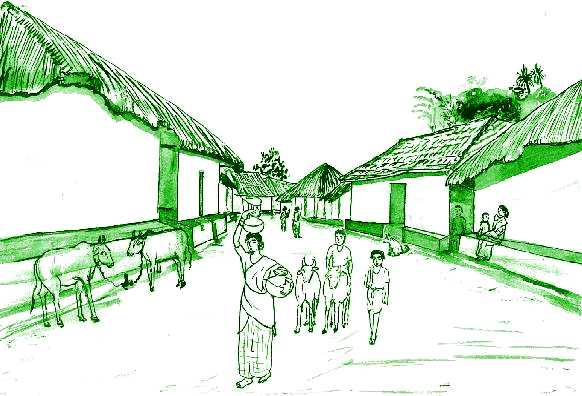
Santal village is usually located far from the beaten track;
for the typical Santal is a child of the jungle and avoids
the main roads and centres of population. Each house is
a picture, the creation of men and women who live close
to nature and possess an inborn talent to be artistic in
almost all that they do.
First
the men go to the jungle to cut the saplings they need for
corner posts and rafters. Then they dig a pit, the women
carrying water to mix the earth in it to a soft, pliable
mud. With this the walls are gradually built up, without
the help of rule and plum-line. In each corner is buried
a stout post, to support the main rafters of the roof, the
outlines of which soon rise steeply angled, from the top
of the walls. If the builder is a wealthy man, he next calls
in the potters to make red tiles with which to cover the
rafters; otherwise he completes it himself, with a thick
layer of thatching grass.
He
then builds a raised platform (pinda) round the outside
of the wall, high enough t afford a comfortable seat, where
he may sun himself (jeder) in the cold weather or enjoy
a crack with his cronies in the cool of a hot weather evening.
The doorway is filled with a rough structure of bamboo of
saplings laced together. Windows and chimneys are rare.
The smoke of the cooking fire finds its way out through
the space between walls and roof.
After
the house is completed a rough and ready byre (gora) is
added, at right angels to one end of it; and the remaining
two sides of a square are shut in by two simple walls, to
form a courtyard (raca). Here, shut off from the public
gaze and protected from hot winds the inmates eat and sleep
during the hotter months of the year.
^TOP^
The
women smear the outside with a water proof coating of earth
mixed with cow-dung, smoothing off the roughness of the
walls, and the homestead is complete. As the sons grow up,
bring in wives, and produce their own families, other little
houses may be build, to house the growing family, replacing
the walls on two sides of the square. The furnishings, too,
are home-made; a cooking place (culha) fashioned of mud,
in a corner of the outer room; some string beds 9parkom);
perhaps a rough stool (gando) or two; a hollowed out tree
trunk to form a mortar (ukhur) and an iron-shod stick to
form a pestle (tok) with which to proud the daily portion
of rice, and rough rack of logs in a corner of the courtyard
to support the water pots (kanda).
The
most of characteristic feature of a Santal village is the
lay out of the houses on either side of a central street
called kulhi; the houses are built up on either side of
the kulhi in rows but the most striking feature is the absence
of doors facing the kulhi; the doors of the houses are built
away from the kulhi. Somewhere near the centre of the village,
usually next to the house of the Manjhi or village chief
is to be found the manjhi than. This is the centre of village
life.
^TOP^
WALL
PAINTINGS:
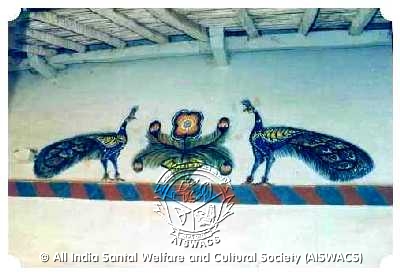
Santals
are an artistic people; their love for art is expressed
in various paintings on the walls of their houses in the
villages. These paintings are reflections of their inner
feelings, their love for their environment which include
the trees, animals and also depicts to a certain extent
their life-styles. Further, these paintings are reminiscences
of their past history and their mythologies describing their
creation concepts and migration.
In
Santal society, their women folks usually accomplish the
wall painting. The women folks begin painting the walls
just before the advent of annual harvesting festival Sohrae
which is usually celebrated in the months of December-January.
After the rainy season in over, the women clean the houses
and plaster the walls with mud so neatly that they serve
as natural canvas for the painting. The Santal women procure
the natural ingredients of the colors, prepare and apply
them on the walls. They use indigenous brushes, pieces of
clothes or even fingertips to apply the colors.
The
colors used in the paintings are plain often decorated with
geometric patterns such as triangles, rectangles, quadrangles
or wavy lines. The must striking characteristic of the wall
paintings are the flowerings with leaves stylized in a different
manner. Besides animals like tigers, birds, fish, elephant,
serpents appear in abstract forms; life styles, day to day
activities and social functions also find their way in the
paintings; thus there are paintings of group dances with
drummers, musicians and women holding hands together.
The
styles and the subject matters of the paintings are also
undergoing changes along with the change in the cultural
environment of the Santals. However, the classical Santal
wall painting can still be seen in remote rural villages
away from the so called modern civilization.
^TOP^



 AISWACS
 Santal
Hul - 150
Santal
Hul - 150