Johar
. Welcome to the charming World of Santals !
 The
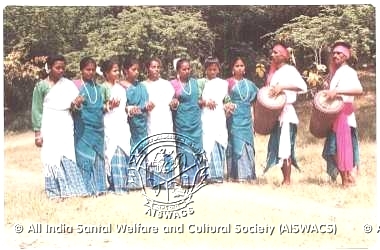
Santals are the largest homogenous tribal group of India
who are considered to be the absolute originals of the land.
With a population of over 10 million , they are concentrated
in the Indian states of Jharkhand, West Bengal and Assam.
They are also sprodically located in the neighbouring countries
of Bangladesh, Nepal and Bhutan in Asia. Being one of the
oldest Adivasi (Indigenous} communities, Santals have their
own socio-political, economic and cultural systems for which
they have sentimental and emotional links and they practice
their rituals relgiously even today. They are endowed with
rich and glorious historical, cultural and political heritages.
Basic human values, which are the essence of a primary human
society like simplicity, truthfulness, respect for elders,
caring and sharing, co-operation, communitarian life-styles,
subsistence economy, human spirituality, collective joy
etc. are still visible in their Society.Mercifully they
are still considered to be a large group of homogenous people
who abhor the materialistic world and resultantly the mad
race for it." Raska" - meaning joy and happiness
is the keyword, which truly gets reflected in every spheres
of their life. Being joyous and contented even in the worst
materialistic situations, they continue to live blessed
with their own simplistic and happy world.
The
Santals are the largest homogenous tribal group of India
who are considered to be the absolute originals of the land.
With a population of over 10 million , they are concentrated
in the Indian states of Jharkhand, West Bengal and Assam.
They are also sprodically located in the neighbouring countries
of Bangladesh, Nepal and Bhutan in Asia. Being one of the
oldest Adivasi (Indigenous} communities, Santals have their
own socio-political, economic and cultural systems for which
they have sentimental and emotional links and they practice
their rituals relgiously even today. They are endowed with
rich and glorious historical, cultural and political heritages.
Basic human values, which are the essence of a primary human
society like simplicity, truthfulness, respect for elders,
caring and sharing, co-operation, communitarian life-styles,
subsistence economy, human spirituality, collective joy
etc. are still visible in their Society.Mercifully they
are still considered to be a large group of homogenous people
who abhor the materialistic world and resultantly the mad
race for it." Raska" - meaning joy and happiness
is the keyword, which truly gets reflected in every spheres
of their life. Being joyous and contented even in the worst
materialistic situations, they continue to live blessed
with their own simplistic and happy world.
 ^TOP^
^TOP^
All
India Santal Welfare and Cultural Society (AISWACS)
is an Adivasi (Tribal) organisation involved in activities
related to the Santals and allied Adivasi Communities for
their empowerment in totality for a firm foundation for
Socio-political, cultural and economic strength.
^TOP^
BOTTOM The Constitutional scheduling of the tribes for administrative
purposes encompasses the entire group into a calibrating
system with notional theory of shuffling around the circle
of idioms in terms of their poverty and backwardness in
formal education. Logically therefore a transition in outlook
of the State deserves priority over transformation of the
state of affairs of the tribals and their ideologies. AISWACS
believes that the root causes of the poverty is the exploitative
tendency and inadequate socio-political and economic structures;
and consequent dispossession from their basic life sustaining
resources comprising of land, forests, water,
The Constitutional scheduling of the tribes for administrative
purposes encompasses the entire group into a calibrating
system with notional theory of shuffling around the circle
of idioms in terms of their poverty and backwardness in
formal education. Logically therefore a transition in outlook
of the State deserves priority over transformation of the
state of affairs of the tribals and their ideologies. AISWACS
believes that the root causes of the poverty is the exploitative
tendency and inadequate socio-political and economic structures;
and consequent dispossession from their basic life sustaining
resources comprising of land, forests, water,
their cultures and values. Experts (Bhattachatya/Tribes
in India; Process of Transitiuon/2003} believe that most
studies on tribes have a cross-cultural perspective since
the academicians generally belong to a cultural strait,
which has a non-tribal ambience and always being conscious
of it. As such parameters used to define the tribal world
are more or less corrupted idioms, which are distant from
objectivity, somehow. The tribes' worldover therefore consolidate
on a horrifying belief that they are guineapigs in the anthropological
laboratory of the enlightened classes of human beings with
terms like ' backwardness, primitiveness or ancient in their
practices' stamped on their existence. Their cultural strengths,
the brevity of their traditional institutions and purity
of existence in a shallowed world never finds mention in
the glare of the limelight. The world needs to learn their
charasteristic positive outlook as a single source of a
stubborn strength and strategy that they have been practicing
in maneovering and carving out a peaceful life either among
themselves or in connection to their non-tribal meighbours.
Presently AISWACS is involved among the Adivasis in the
States of Jharkhand and adjoining areas of Bihar, West Bengal
and Orissa. Strategically, AISWACS believes in facilitating
movements to attain social transformation for the holistic
upliftment of the entire community.
^TOP^



 AISWACS
 Santal
Hul - 150
Santal
Hul - 150