SANTAL
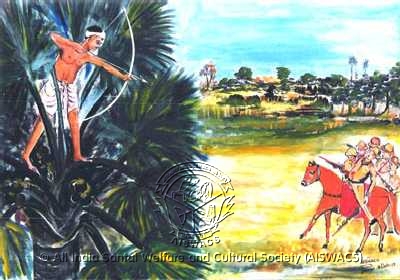
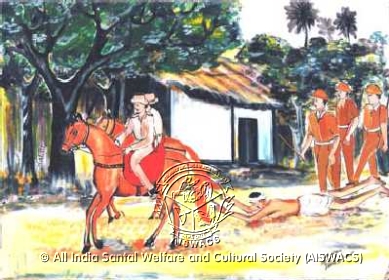
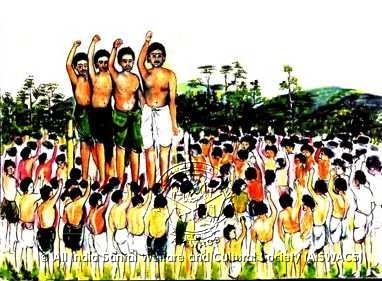
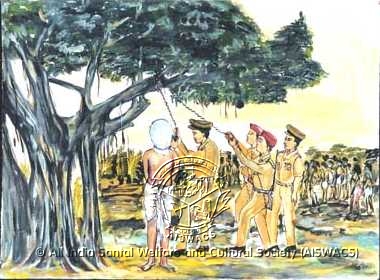
HUL 1855-57
 ^TOP^
BOTTOM
^TOP^
BOTTOM
Introduction
Social movements among Indias tribals have been widely prevalent
during and after the British Raj. In fact over a period
of nearly two hundred years there have been more than seventy
tribal uprisings throughout the country. Following these
tribal rebellions and, in certain cases even without such
precedence, a number of reformative movements were started.
No account of the Santals can be complete without reference
to the Santal Rebellion of 1855-57, a landmark in their
history. It has become a legend treasured by tribals as
well as non-tribals, as can be seen from the number of dramas
and songs celebrating this event and mythologising its leaders
while, at the same time, constantly reviving in the minds
of the present day Santals the memory of the event.
SANTAL
HUL - CAUSES
The
Rebellion was not begun on the spur of the moment as a result
of sudden passion, but it was the result of a long endurance
of exploitation and oppression. It came at a time when the
destitution and sufferings of the Santals had reached an
extremely high level. Among the various causes, which led
the Santals to rebel, the most commonly cited is the merciless
exploitation of the grasping and rapacious mahajans or money-lenders
and by the zamindars or landlords. During the same time
that the Santals began occupying the Damin-I-koh (an area
surrounding the Rajmahal Hills and comprising 1,366 square
miles demarcated by the British government in 1833 and declared
as government property) large numbers of Hindu traders and
moneylenders began to infiltrate the area. When the spendthrift
Santals took loans, they more often than not found themselves
trapped in a vicious circle of extortion from which they
could not escape in their lifetime. Before long, as a result
of the usurious rates of interest, fraudulent dealings in
the use of measures, weights and prices used in the execution
of bonds, these merohants nad money-lenders amassed large
fortunes at the cost of the simple and honest Santals who
were in turn reduced to utter misery. The immigrant landlords
took advantage of the Santals misfortunes and started exacting
heavy taxes, which the over-burdened Santals could never
possibly pay. The revenue administration organised to collect
rent and settle land disputes was riddled with corruption.
As a result of all these factors the Santals were being
forcibly ousted out of their own property.
The
Santals had made a number of attempts at presenting their
grievances to the government. These were, however, repeatedly
rebuffed and the aggrieved Santals could never get judicial
redressal. For civil and criminal cases the Santals were
forced to go to the courts at Deoghar or Bhagalpur, which
even today with the modern means of transport are considered
to be far away places out of the reach of the ordinary villager.
Moreover the prevalent oppression of the Santal Police Rules
and the corruption of the judicial administration especially
of the amlahs (clerks), mukthears (pleaders) and peons,
rendered the making of such long journeys to Deoghar and
Bhagalpur to no avail. Since the Santals did not know any
language other than Santali, they were forced to make use
of interpreters and pleaders and also of clerks to file
their grievances before the judges. All these were in turn
in the pay of the landlords, traders and moneylenders. The
courts of law supposedly the guardians of justice, thus
gave more security to the propertied classes and as far
as the Santals were concerned legalised the rapacity of
their oppressors. They found themselves subjected to a forcible
dispossession of property, abuse, personal violence and
a variety of petty tyrannies.
However,
though the Santals demands, which preceded the rebellion
were mainly concerned with the improvement of their general
economic situation, three other factors were of paramount
importance in forcing the Santals to revolt en masse.
(a)
The importance of land:
For the Santals, land not only provides them with economic
security but is also a powerful link with their ancestors
whom they keep in very high esteem and veneration. No land
is taken possession of, no site for a new village is selected
unless the ancestral spirits first approve of it. For the
Santals land is thus part of their spiritual as well as
their economic heritage. Following this belief according
to their tribal customary laws and practices, the village
as a whole owned much of the land collectively. The idea
of individually owned land was unheard of. The English government,
however, which more often than not were completely ignorant
of the tribal's traditions and customs.They could not conceive
of such traditional beliefs. They knew only of one pattern
of land ownership - individual ownership. This principle
guided a number of land legislations, which instead of benefitting
the Santals, the original owners of the land, encouraged
the Deku settlers to acquire more and more land forcibly
mortgaged by the Santlas.
(b)
The honour of their womenfolk:
Though the introduction of the railway and of indigo plantation
in Santal Parganas was a source of material gain to the
Santal workers, both factors soon turned out to be a threat
to the Santals' long cherished traditions and customs especially
those concerning their tribal marriage code. In Santal society,
women enjoy a high degree of respect and of equality with
the menfolk. Any immodesty shown to them provokes intense
and angry disapproval and is treated with great severity.
Such actions also incur the wrath of the village spirits
who are said to become polluted with the result that they
stop protecting the villagers. According to their traditions,
the Santal ancestors twice ran away form the country in
which they were living rather than submit their women to
marrying outsiders or persons not of the tribe (Volume 2).
Now the Santals were often seeing their womenfolk being
forcibly abducted and dishonoured by European railway men
and indigo planters.
(c)
Yearning for Independence
Another important element in the complex of factors which
led to the Santal rebellion, was the yearning for independence
- the dream of ancient times when the Santals were said
to be their own masters without any overlords. This urge
for independence reached its climax when the two brothers
sido and Kanhu proclaimed that they had received a divine
message from Thakur Jiu, the supreme deity of the Santals
into an open revolt against their oppressors. This religious
sanction gave the leaders the authority they required to
be accepted by the Santals at large and to start the rebellion.
Everyone firmly believed that the gods could not fail them.
On 30 June 1855, more than 30,000 Santals rose in arms.^TOP^
BOTTOM
THE
HUL - GENESIS THEREOF
The
account by W. J. Culshaw is the first attempt to review
the Santal rebellion from a new angle and to avail of the
important evidence of Chotrae Deshmanjhi reak' Katha.
Among
Indian rebellions, the revolt of the Santal's is unique
in having inspired and English novel. Harma's Village by
R. Carstairs vividly reconstructs its wild course and there
is probably no better and certainly no more sympathetic
introduction to the Santal of that period.
The
following excerpt, which gives an idea of its quality, concerns
the memorable scene in which a sub-inspector and money-lender
were confronted by Sido and Kanhu. The sub-inspector had
arrested certain Santal's and was on his way to Bhagalpur.
A
white mist covered the River and its banks when the Daroga
and his company reached Pachkattia. Day had dawned, but
the sun was shadow-like because of the silence, -- they
saw standing in the way they were to go a multitude -- all
men; all Santal's; all armed. The Daroga halted. The prisoners,
who had been walking with their eyes fixed sullenly on the
ground, looked up and saw the dense crowd before them. Neither
they nor the Daroga thought of its having anything to do
with them.
To
all appearance it was a peaceful assembly. But what mean
those lines of faces together and all looking one way; the
grim, fierce eyes, looking out from beneath nodding plumes
of shaggy hair, and the axe, bow, sword or club grasped
in every hand?
Kenaram
flinched, but not the Daroga. Strong in the prestige of
"Sirkar", whom he served, and accustomed to throw
himself alone or with one or two men into a seething mob
of rioters, he rode steadily, Kenaram at his elbow, and
his followers with the prisoners pressing close behind --
rode steadily into the midst of the Santal's, purposing
to pass through them. In unbroken silence their ranks opened,
and a narrow lane wide enough to admit four men abreast
was made. Into this lane, lined on either side with men
facing inwards, the Daroga rode, glancing haughtily to the
right and left among the scowling faces as if in search
of a leader worthy to answer his questions.
Opposite
the embankment further progress was berred by a dense mass
of men drawn up across the way. He stopped, Kenaram with
him, and per force, his followers behind him. In the rear,
in front and on his rught the crowd closed in as a quick
and closes round a ship that has touched a shoal. Only on
his left the slope of the embankment from where he stood
up to the foot of the Peepul tree remained clear. The deep
silence was hardly broken by the champing of the two ponies
on their bits. Through the silence and the mist there cut
the stern, harsh voice of the Daroga asking what this meant.
Fierce and sharp, sounding very loud in the silence, a voice
pealed forth from above :-- "Be more respectful in
the Presence dog! Make a reverence to their Highnesses!"
The
Daroga, taken back, looked up and saw standing at the foot
of the Peepul tree two young men - the Brothers- surrounded
by their armed guard. It was one of this body who had stepped
from his place in the ranks, and addressed the Daroga in
language he had often used to others, but which no man had
ever before used to him. The Daroga felt that he was in
a strange atmosphere, but that boldness was his best chance.
"What
is this, young men", he said, in a tone of reproof;
"and who be ye? Know ye the penalty for insulting and
officer of Sirkar on duty?"
"What
means this that I see free Hor being led captive within
my country, without leave?" cried Kanoo in a loud voice.
"Cut their bonds!" "Beware, touch them not!"
thundered the Daroga. Then, turning to the Brothers, and
putting on his fiercest professional scowl, he angrily asked:--
"Who be ye, who take on you to meddle with Sirkar's
business?"
"I
am Kanoo", said one, " and this is my country!"
"They
be the men of the wheel, to whom the goddess has given the
country". Cried a man of the guard.
"Hey!
The men of the Wheel! -- Kanoo and Sidoo, Hoy!" cried
another Round the vast throng rolled a deep growl, like
thunder.
"Cut
the bonds!" roared Kanoo; and as he spake the four
prisoners were forced out of the hands of their guard. The
voice of the multitude, as it saw this, rose deeper and
stronger.
The
frightened Kenaram, and the Daroga, enraged but impotent,
were made to dismount. Their umbrellas were taken from them,
their ponies were led away, and they themselves, grinding
their teeth with unconcealed rage, were made to do humble
obeisance to the Brothers. Then they were granted permission
to leave the Presence.
But
arrogance was ingrained in the Daroga's nature. Not content
with escaping alive, he must still demand his prisoners,
and threaten the people with the dire consequences of defying
Sirkar.
Kanoo
had gone to sleep last night a dreamer of dreams : he was
suddenly become a ruler of men; and thought it no strange
thing that he, a humble and unknown Hor, should be bandying
words with the redoubtable Daroga. Without heat, or show
of remper, he replied to the indignant officer: -- "Be
content and pass on. These be our men. ye their lords, and
will judge them. Hast thou aught against them? Then prove
it to our satisfaction".
"I
will prove it before the Courts of Sirkar", said the
Daroga angrily, "and before none other! Never was heard
such presumption! I call you to witness" (turning to
the horror-stricken Kenaram and their followers) "that
I have been forcibly deprived of my lawful prisoners; and
I warn you, Kanoo and Sidoo, who say the country is yours,
that this is rebellion, for which ye will hang! Be wise:
give me back my prisoners!"
"We
have said!" was Kanoo's only reply.
"I
go to the Hakim then", said the Daroga firmly. "Make
way there!" and the people began to make way, so great
was the prestige of Sirkar, and of Sirkar's officer, the
Daroga.
"Give
us our horses!" said the Daroga haughtily.
"Wait
until ye are out of sight", said one of the bodyguard.
"No man mouths horse in the Presence!"
"Think
on Heen's spear, Kenaramji!" cried a voice from the
crowd. At this sally there was a general roar, for the tale
of the usurer's overthrow in the Jungipur bazaar had flown
all over the country. Sweeter music than this laughter Kenaram
had never heard. Every successive defiance uttered by the
Daroga had added to his terror. The people laughed -- he
might yet get out of this alive!
The
Daroga's arrogance would not allow him to go without a last
word. In vain Kenaram plucked eagerly at his arm. Turning
to the brothers, he cried aloud:-- "I know those who
have insulted Sirkar by rescuing my prisoners; and them
I will bind even as my prisoners were bound!"
"Thou
wilt want a cartload of ropes", cried one: "for
ye will have to tie us all up!"
The
Daroga turned and stalked haughtily after Kenaram who, in
a fever ho be off, was urging him to quicken his pace; but
this pride forbade him to do.
Meantime,
one by one, the captives had been released. The last to
be released was Gorbhoo.
Now
Gorbhoo's hatred of Kenaram, the man who had entrapped him,
deserted him, and seen unmoved the sufferings of the last
few days, had grown and grown until it filled his whole
soul. At the sight of his tyrant walking off quietly with
the Daroga, it blazed into an uncontrollable frenzy. Snatching
a battle -axe from one of the crowd, the giant Manjhi uttered
a wild scream of "HOOL! HOOL!" rushed on the usurer,
and with a smashing blow felled him to the ground. Blow
upon blow he struck on Kenaram's senseless body, showering
invectives of the dead man as the cause of all his misfortunes.
The crowd, at first alarmed, then astonished, quickly caught
his frenzy, and joined in his cry of "HOOL ! HOOL!"
until the whole air was full of it; while the men nearest
to the body added their useless blows to those of Gorbhoo.
Suddenly
Garbhoo, splashed with Kenaram's blood, turned to where
stood the Daroga cowed at last, livid with fright, trembling,
willing to flee had a way been open : but the crowd had
closed him in.
"Kill
the Daroga !" shrieked Garbhoo, and leapt at him with
the terrible axe.
In
vain the Daroga tried to take shelter among the crowd. The
crowd was impenetrable, and threw him off. For a few moments
he delayed his fate by catching Garbhoo's upraised arm,
though no match for the Sonthal giant, he was a powerful
man. But another axe did the work, and he sank to the ground
beside Kenaram.
The Daroga's burkundazes and Kenaram's men, all but a few
who, seeing what was to come, had disappeared in time, were
next attached. Sick with horror,. Harma saw them struck
down one after another. The raging, howling mob of Sonthals,
mad with the lust of slaughter, when they had no more living
victims, hacked and mutilated the bodies of those they had
already destroyed. Were these the good-natured, merry folk
he had seen only a few minutes before; and was this what
the Hool turned men into ? He shuddered at the thought of
the terrible times coming.
Kanoo
and Sidoo had no misgivings. It was the SIGN. Their time
of waiting was over. The great day had come!
When
the rage of the people had been spend; when the mob at length
left the shapeless pulp that had once been Kenaram, the
Daroga and their men, and stood about spattered with blood,
their eyes red with murder, the minds of the Brothers were
made up. Kanoo cried with a loud voice : "The Hool
has begun! Send round the Sal branch! There is no Daroga,
no Hakim, no Sirkar! The RAJ of the HOR is come!"
And
the people, brandishing their bloody weapons, shouted "HOOL!
HOOL! No more Daroga..No more badgement.. no more usurers!
Hail, Kanoo and Sidoo, Men of the Wheel, lords of the Hor!^TOP^
BOTTOM
THE
PROGRESS OF THE HUL
The
official account of the Rebellion is given in Mc Pherson's
Settlement Report, and as this is not easily available it
will perhaps be of interest if I reproduce it here.
"The
progress of the peaceful development of the district was
rudely but only temporarily interrupted by the Santal rebellion
which broke out in the Damin-i-Koh on the last day of June
1855. The outbreak was quite unexpected and by none more
so than by Mr. Pontet, as his letters of that year disclose.
A certain amount of unrest had been noticed in the cold
weather of 1854-55 and Mr. Pontet in his annual report of
28 May 1855 discussed the relations of the Santal's with
their Mahajans, the extortionate interest of 50 percent
charged by the latter and also certain complaints against
the railway people, who were making the new Loop line from
Burdwan to Rajmahal; but so far as revenue demands were
concerned there was perfect contentment, and it never crossed
Mr. Pontet's mind that the other grievances of the Santal's
would lead to open revolt. It was exactly one month after
this letter was written that 10,000 Santal's gathered together
at Bhognadih in the heart of the Barhait valley under the
leadership of the four brothers Siddhu, Kanhu, Chand and
Bhairab and proclaimed was against mahajans, zamindars and
all rich Beengalis. On the 7th July the daroga of thana
Dighi attempted treacherously to arrest the leaders of the
revolt and was himself killed with nine of his escort. Mr.
Pontet had attempted to use his influence with the Sonthals
within the Damin, but found his efforts in vain and reported
in July that he could 'never again consider himself safe
without firearms'. There were no troops at hand to contend
with the insurgents except the Hill Rangers stationed at
Bhagalpur. These advanced to Clogging, but on 16th July
were defeated by the Sonthals at Piolapur with the loss
of their sergeant-major and 25 men. The rebels then got
out of hand and committed numerous acts of atrocity, butchering
many of the mahajans who had held them for so many years
in a state of bondage.
But
the Hill Rangers were speedily reinforced by European troops
and native infantry and by the end of August they had cleared
the country on the Bhagalpur side of Santal insurgents,
inflicting a serious defeat upon them at Sangrampur. East
of the hills Rajmahal was saved by exertions of Mr. Vigors,
railway Engineer, who fortified his residence there. On
the Murshidabad side Mr. Toogood, Magistrate of the district,
brought up troops from Berhampur and inflicted signal defeats
on the Sonthals at Maheshpur and again at Raghunathpur on
24th July. Further, operations against the rebels were postponed
on account of the rains. There were still about 30,000 of
them under arms, and they began to display renewed activity,
especially on the Birbhum side. Martial law, at first refused
by the Government of India, was proclaimed on 10th November
over Bhagalpur right of the Ganges, Murshidabad right of
the Bhagirathi and the whole Birbhum district. The disturbed
country was then swept by some 8,000 troops under the command
of Major General Lloyd and Brigadier General Bird and by
the last day of the year the rebellion was officially declared
to be at an end. Martial law was suspended on 3rd January,
1856. The work of revenue collection within the Damin-i-koh
had been resumed before that date. The Dumka Damin remained
longest disturbed. In Rajmahal and Pakaur Mr. Pontet reported
in January that more that one-fourth of the raiyats had
already settled down again, and he expected to realise one-half
of the past year's revenue. In the Godda Damin, which was
first pacified, he expected three-fourths. By the following
year, collections were again in full swing. The Sonthals
were excluded from the working of Regulation I of 1827 and
exposed to the rapacity of police and civil court underlings
of Bhagalpur, working hand and glove with extortionate mahajans
and, outside the Damin-i-koh, oppressive zaminders. Mr.
Pontet had no police or magisterial powers and could not
do much to protect them. When he attempted to interfere,
he was snubbed. The following is Jugia Haram's version.
'Owing
to the trouble caused by the Dekos and the pangs of hunger
and after crossing the Ajai river we gradually spread towards
the north and east, to the hills and the banks of the Ganges.
At that time there was only forest with Bhuiyas here and
there, and on the hills, Mar Mundas. These Mundas are also
called Sauaria. At that time there was only forest with
Bhuiyas here and there, and on the hills, Mar Mundas. These
Mundas are also called Sauria. At that time the Bhuiyas
and Mar Mundas were kings. They gave out land by agreement
and took very little rent. Under them we had no trouble.
But day by day the Dekos entered for trade and at last settled
as money lenders. They became the king's money lenders also.
Having taken money and clothes from the money lenders, the
kings pledged their lands with them. In that way the Deko
money lenders acquired the whole land by fraud, and became
kings themselves while the real kings grew poor like us.
The Deko kings who were living near the hills encroached
on the lands of the Mar.
We
cleared the hills and forest for these new kings by taking
loans from the money lenders and in return these kings levied
rent from us. The money lenders give us little and take
a great deal. They take the year's crop and we have then
to take fresh loans from them. However, much we pay they
are never satisfied. If they are not satisfied with the
year's crop they drive away our cattle. If the debt is not
repaid even then, we work at their houses with our women
and children for one or two pais of rice. As there were
no officers, to whom could we cry? Then came Deko police.
But they were won over by the white money of their own caste
men and dismissed our cases. We had great trouble and they
harassed the whole country.
Then
great rumours arose. At the first it was said that the lag
lagin snakes were moving around and swallowing men. To remove
this evil the people of five villages met together and after
fasting, went in the night to another group of five villages.
Men of five villages, one from each house, came to our village.
They beat drums at the outer door of the manjhi's house
and danced round it. They hung wooden bells round their
waists and the swaying of their bodies made the bells give
out a great sound. Two unmarried boys put on the sacred
thread and carried round in a basket two small ploughs made
of nim and bel wood and marked with vermilion. After doing
a round of five villages, they assembled the villagers in
an open place at the last village. There in the name of
the lag lagin snakes they offered bel leaves,. arwa rice,
oil and vermilion. After that, they taught each village
the catch song and putting the sacred thread on two of our
unmarried boys gave them the ploughs and returned to their
houses. We then joined four other villages and went round
five villages in the same way. After doing a round of five
villages, we entrusted the two ploughs to the villagers
of the five villages and put the sacred thread on two of
their unmarried boys. We worshipped in the name of the lag
lagin snakes and having taught them the song returned home.
When we returned the men cleaned the courtyards and the
cowsheds and brought a pot full of water. As long as their
men were away in the night, our wives did not put their
feet to the ground but kept cowdung by their cots, put their
feet upon it and suckled their children.
After
this they spread another rumour. Those women who had an
equal number of children swore eternal friendship and exchanged
flowers in groups of two. They exchanged clothes and ate
and drank together. Why, no one knows. Perhaps it was to
keep a solid front and be all related so that when the rebellion
began no one would speak behind another's back and whatever
happened would be kept secret.
Yet
another rumour grew. People said, 'a buffalo cow is moving
in the country. Wherever it finds grass at someone's outer
door, it halts and grazes and until all the members of that
household have died it does not move away'. Therefore throughout
the land they dug up all the grass in the village streets.
There
was also a rumour about Doms. In the Ganges, a Dom touched
a golden boat and it sank. Because of that all Doom's would
be haoked down and killed. For that reason out of fear the
Doom's began to move like stage in a forest. They dressed
like Santal's and lived in Santal houses.
Then
a rumour spread that in layo Gar a leader had been born
to an unmarried girl and every one would go and hunt there./
Layo Gar is beyond Hazaribagh. Some people went, saw the
leader and hunted with him in the Kanchan forest. All the
deer they killed they collected at one place and cut in
pieces. Each man brought a leaf for taking back his share.
They counted the leaves and saw how many thousands had assembled.
The leader paid all the expenses. When they parted the leader
said, "We shall hunt in the Tiur Forest near Deoghar.
Gather there". But for some reason they did not do
so.
Then
another rumour arose. "People are coming to kill the
Dekos. Hang up at the end of the village street, a bullock
skin and a flute, so that they will know that you are Santal's.
Otherwise they will kill all of you." So fearing this
would happen we hung up these things in every village.
Then
it was heard that in the Par country in Bhognadi a Suba
Thakur had arisen. Hearing this, people began to set off,
each with a pai measure of arwa rice and the milk of a cow.
There they saw an altar and round it a railing. In the middle
the Thakur was sitting in the guise of Sido of that village.
They saluted him and did homage, falling at his feet and
placing all the rice and milk before him. Then the Hakim's
Daroga came. He said, Where is your permission? Show me
your authority. Then Sidu said "This is my authority"
and he killed the Daroga with his knife.
After that, the rebellion began. They heard that the Daroga
had been killed and constables came. At Keopara they fought
with Sido and his brother Kanhu and the Santal's of the
country. The constables were defeated. This elated Sido
and Kanhu and their followers. Sido and Kanhu ordered, "Kill
all the kings and mahajans, and chase the other Dekos beyond
the Ganges. We shall have our own rule". The Santal's
of the country began to thirst for blood and many Suba Thakur's
arose.
Then
battles took place in Pakur and Maheshpur. There also the
police constables were defeated. Then the Jamolpani Mani
in Nankar. They and the Santal's ravaged the country side
and looted Naranpur and Nolhati. Then Binod Manjhi of Nelparta
Tilaboni became a Suba. He with other Santal's looted Deoca
and Gunpura. At Gunpura the Santal's were defeated. Then
they fought at the Nangllia thana. There the Santal's were
killed in great numbers. Then beyond the Mor river at Laubaria
they fought. There a host of police constables were killed
and also an Englishman. An the Santal's were shot down in
heaps. The Santal's did not win. They went to the Suptola
forest and the Satbahor hill and took refuge. They remained
there for two months in Asin and Kartik. Then Santal's killed
Santal's from hunger. Englishmen surrounded us and drove
us to Sikarpur and Ramkhari.
Whichever
Santal's of us who were arrested were taken to Dhasnia.
After keeping us there a month they brought us to Kumarabad
near the Maurakhi river. There the Englishmen coaxed us.
They said "Why need you suffer ? Tell us the leaders
and we will let you go at once". Then the people told
them. The English caught the leaders. Some they hanged on
the spot, and some they transported for life. Some of them
they released. Sido had died in battle and Kanhu and others
were caught later on. They hanged Kanhu and one or two others
and many were transported. Ram Manjhi and Bonode slipped
away. As for us, the Governor came and settled the matter
and we returned to our village.
During
the rebellion we suffered much. From Asar for three months
we were in the forests under the trees. It poured with rain.
We almost died of hunger, all because of the false words
of those Suba Thakur cheats. In the rebellion many of us
lost our cattle, and when we went back to the village we
were in great trouble. There were no plough cattle. There
was nothing to eat, and the Dekos laughed at us and once
again the money lenders got us in their hands".^TOP^
BOTTOM
IMPACT
OF HUL
(a)
Though the Santals were unsuccessful, they did
manage to draw the attention of the British government which
till then was completely ignorant of the peoples oppressive
conditions and the corruption in the administration which
was left in the hands of Darogas and others. Judicial and
administrative reforms were soon adopted and by Act XXXVII
dated December 22, 1855, the territory in and around the
Damin-I-koh was formed into a separate non-regulation district
called Santal Parganas.
(b)
A direct communication between the people and the government
was set up and attempt was made to utilise the Santal village
organisation and tribal polity in administering the area.
(c)
The period following the rebellion, however, was not quite
peaceful inspite of such legislations and reforms. Slowly
the newly erected district began to slide back into the
regulation system and the privileges of the Santals were
being once more taken away from them. With the opening of
new means of communication, more Dikus from North Bihar
and from Calcutta especially, swarmed into the district.
They were more than willing to lend money to the simple
Santals in exchange of their land. The government did not
make any arrangements for cheap agricultural credit to the
Santals, nor did it do anything to curtail the high rates
of interest levied by the money - lenders. On the contrary,
the Santals were made to pay everincreasing rents and the
alien landlords usurped a lot of rent-free land. A spirit
of resentment once again swept throughout the whole district.
Many Santals joined other tribals in the 1957-59 Sepoy Mutiny
against the British government. Contrary to perverted reprots
given by British chroniclers, the mutiny in Chotanagpur
and Santal Parganas was very popular and widespread. This
was mostly due to the fact that the estrangement between
the tribals and the British government was more acutely
felt in these areas. The tribals were once more ruthlessly
suppressed.
^TOP^
BOTTOM
POST
INDEPENDANCE MOVEMENTS
1948
: Justin Richard organized the United Jharkhand
Block in 1948 at Chkradharpur in cooperation with Jaipal
Singh. However, after the Kharsawan firing of 1948, both
parted ways.
1950 : Formation of
the Jharkhand Party. Under the leadership of Jaipal Singh,
an oxford educated Munda, the influence of the Adivasi
Mahasabha spread all over the Chotanagpur plateau. The
need for broad basing the organisation by including non-tribals
also was given a thought. The general session of the Mahasabha
held at Jamshedpur decided that, though the Mahasabha
would remain essentially a tribal orgnaisation, its membership
would be extended to non-adivasi Jhaarkhandis. It grew
from a purely tribal organisation into a regional political
party. In the first General election of the independent
India in 1952, the party adopted the cock as its symbol,
symbolizing 'day break ' or tribal awkening. It won all
the 32 seats in the Bihar legislative Assembly it contested
to emerge as the main opposition party.
1955
: Demand for Jharkhand Alag Pranth before the
State Reorgnisation Commission : Emphasising the economic,
political and cultural imperative for the formation of
a separate state, a memorandum was presented indicating
that the tribals are distinct from the non-tribals ethnically,culturally
and linguistically. They wanted Jharkhand to be curved
out of six dfistricts of Bihar and nine districts of Bengal,
Orissa and Madhya Pradesh. The demand was turned down
on the grounds that the tribals of Jharkhand did not have
a common language.
1956
: The decline of Jhanrkhand Party begins ;
The tribals became disillusioned with the Jharkhand Party.
In 1957 election, the number of votes polled by the Jharkhand
Party was smaller than those polled in 1952. The third
general election of 1962 came as a shock to its leaders.
The number of votes polled plummeted to 4.67 lakh in 1962
as against 7.51 lakhs in 1957 and 7.66 lakhs in 1952.
The main reasons being the aloofness of its leaders from
the masses.
1963
: Merger of the Jharkhand Party with the Congress:
Being tired of sitting in the opposition, its leaders
thought that it could achieve its motto only if they merge
with the mainstream national party. The rank and file
was not happy with this decision and the Council of the
party never ratified it.
1967
: Fourth General Election; Fragmentation of
the Jharkhand Party: The Jharkhand Party was broken to
pieces with even non tribals like Lal Harihar Nath Sahadeo
- a Hindu advocate from Ranchi claiming his group representing
the party. The other important claimants were Paul Dayal,
P.K.Lakra and Justin Richard. The Election Commission
could not decide upon the originality and the old 'Cock'
symbol was given to none. 28th Dec, 1967 saw the birth
of All India Jharkhand party which declared the merger
with Congress as unconstitutional. It saw many splits
thereafter also. A group of young men named Lalit Kujur,
Prem Kujur, Moses Guria and Pius Lakra formed the Birsa
Seva Dal to demand joibs for tribal youths in the industrial
undertakings. It also demanded expulsion of non-chotanagpuris
through violent means.
1969
: Formation of the Hul Jharkhand Party : The
Mid term general election of 1969 saw the formation of
Hul Jharkhand Party headed by Justin Richard, the leader
of one split group. It was recognised by the Election
Commission of India and won seven seats. Richard took
advantage of the anti-money lending activities of the
Sibu Murmu, a leftist Santal worker who had gone underground.
The party also split up in 1970, the break away fraction
led by Sibu Murmu formed the Bihar progressive Hul Jharkhand
Party. In the later years the Jharkhand movement was piloted
on factional basis. Thus the All India Jharkhand party
led by Begun Sumbrui drew its support mainly from the
Hos of Singhbhum. Similarly the Mundas supported the Jharkhand
party led by N. E.Horo. The Hul Jharkhand Party headed
by Sibu Mrmu bcame the party of the Santals.
1969
: The Naxalite movement in Jharkhand : In the
dense forested regions of Jharkhand, anti national activities
of the Naxals grew its head during the year 1969. There
were many murders and violent clases. The movement was
controlled by 1971 and its leaders were arrested.
1973
: Formation of the Jharkhand Mukti Morcha :
Destiny provided a new turn to the Jharkhand movement
from 1972 onwards. It was for the first time that the
industrial workers and the peasants came together to fight
against exploitation. It turned into a class struggle
and on February, 4 , 1973, at Dhanbad, the Sonat Santal
Samaj of Shibu Soren and the Shivaji Samaj led by Binod
Bihari Mahato merged together and formed the Jharkhand
Mukti Morcha. The Morcha had as its idelogical father
the trade union leader A.K.Roy of the Marxist Coordination
Committee. The Morcha launched operation to recover alienated
lands from the moneylenders and initiatives were taken
for agrarian radicalism and cultural revivalism. It organized
forcible harvesting of crops standing on lands illegally
taken from Adivasis, Kurmis, Harijans and poor Muslims
bythe moneylenders. At long last landless labourers and
industrial workers found a popular movement against exploitation
on four fronts and incucated cooperative farming and literacy
programmes.
1975
- 1978 : Initiatives on separate Jharkhand
State ; In the beginning the Morcha operated under the
leadership of a triumvirate - A.K.Roy, Binod Bihari Mahato
and Shibu Soren. Roy operated amongst the colliery workers,
which comprised mainly of tribals, Mahato among the Kurmi
peasants and Shibu among the tribals. The coordination
did not last long and Shibuy moved away from the other
two and became closer to the congress in 1980 which resulted
in the Jmm bagging 14 seats in the Legislative Assembly.
1978 : The forst andolan in Singhbhum ;During the year
1978, the Kolhan Porabat area of Singhbhum district witnessed
an well organiserd and formidable andolan known as the
Jangal Katai andolan and some of the best Sal forest of
the area was mowed down by the adivasis. The Sal trees
were felled as a symbolic protest against the threat to
their livelihood and identity. This movement got into
a tremendous response and was coupled with the movement
for the formation of a separate State. The State reacted
repressively. A united front ( Samyukta Morcha ) was launched.
1981
: Moving away from their now famous agenda
of a Separate State, for the first time in the history
of the tribal movement in Jhakhand an attempt was made
to form an independent nation for the Hos of Kolhan by
an orgnisation called Kolhan Raksha Sangh. They claimed
a part of Singhbhum. During the British time, the Kolhan
was Government Estate and the administration of this area
was according to the Wilkinson's rules without recourse
to civil courts Mundas and Mankis were responsible for
land settelement and general superintendence over the
village revenue system. On March 30, 1981, the Kolhan
Raksha Sangh held a meeting at Chaibasa and proclaimed
that the Kolhan had not been part of the British India
ruled by the Viceroy from Delhi and that the Indian Parliament
had no powers to pass laws since Kolhan was a soverign
state.
1985
: A voice to demand declaration of the Chotanagpur
and Santal Paraganas as Centrally administered territory
was placed before the Home Minister at Patna when he was
meeting more than 50 MLAs from this area to find out the
problem of the region. The leadership of this move was
given by Devendra Nath Champia, a Congress (I) MLA from
Singhbhum.
1986 : The active
involvement of students gained strength again after the
first two initiatives in 1966-67 when the students joined
hands with Birsa Seva Dal's movements and in 1977-78 during
the Jaiprakash Narain movement under the leadership of
Salkhan Murmu and Karma Oraon. From 1986 onwards the leadership
was vested upon Surya Singh Besra under the AJSU.
1987
: Formation of the Jhakhand Coordination Committee
In order to forge ahead a common front, a conference of
429 delegates of all political, social, cultural and literary
organisation was held from Septemer 11-13, 1987. However
the coordinated effort again got diluted on ideological
fronts and the AJSU, the JMM and JCC went ahead with separate
initiatives for demand a separate state.
1988 : The Bharatiya
Janata Party jumped into the bandwagon to demand a separate
Nananchal state consisting of Chotanagpur and Santal Paraganas.
This provided lot of election advantage to the BJP. In
1989 under the centers initiatives a Committee on Jharkhand
matters (COJM) was formed to examine and recommend modalities
for meeting the just aspirations of the people of the
region within the framework of the Constitution. The Committee
submitted its report on May 18, 1990 sugesting three possible
solutions to the Jharkhand Problem ; (1) Statehood (2)
Union Territory and { 3 } Jhakhand General Council withinthe
State of Bihar.
1991 : Formation of
the Jhakhand Peoples Party ; The year saw the AJSU taking
up the slogan of " No election without Jharkhand
". It had little impact in the Lok Sabha elections
held in the same year and therefore policy was changed
to join the election politics. Dr. Ram Dayal Munda was
chosen as the first President of the party named Jharkhand
Peoples Party with Surya Singh Besra as its Chief Secretary..
It subsequently became an ally of the Janata Dal in the
mid term elections and won 19 Assembly seats. The party
by them was fragmented when Dr. Ram Dayal Munda and S.S.Besra
joined JMM(S), James Horo took the leadership of the Munda
fction. With the support of JMM and other parties, the
Janata Dal Government in Bihar under the Chief Minister
Laloo Prasad Yadav pushed ahead throughthe Bihar Assembly
a bill on the formation of the Jharkhand Area Development
Council. The then Home Minister S.B.Chavan announced that
provided the fourt Chief Ministers of Bihar, Orissa, Madhya
Pradesh and West Bengal agreed, the Centre may not be
averse to the formation of a separate Jharkhand State.
A meeting of the four Chief Ministers was held on February
18, 1992, but it was Laloo Yadav and Jyoti Basu who made
it. Next month, the different Jharkhand groups decided
on going ahead with their agitational programmes and economic
blockades to create pressure on the Centre. Meanwhile
the JMM split again on the selection of Subodh Kant Sahay
as the nominee of the JMM for the Rajya Sabha election.
A group led by Krishna Mardi opposed the move and supported
the Laloo government. The other group led by Shibu Soren
supported the move and decided to withdraw support to
the Laloo government. It was at this juncture that the
Union Home Minister announced at the August 1992, that
a decision on Jharkhnad could be taken in fortnight's
time. On September, 8, the Home Minister surprisingly
stated that the only way out of the impasse was togrant
Union Territory or separate state status to Jhakhand.
The Narasimha Rao Government at the Centre withstood the
No confidence motion at the Centre on the support of four
JMM MPs in 1993.
1994
: On August9, 1995, the Bihar Assembly passed
the Jharkhand Area Autonomus council and council was sworn
in. During the Genral Election to the Parliament in 1995,
the BJP won most of the seats from the Jharkhand area.
1997-
99 : Lallo Prasad Yadav was forced to step
down as Chief Minister of Bihar although he used his manoevering
skills to buy JMM promising separate Jharkhand State and
had a resolution passed . He was thus able to salvage
his government with the changed leadership.
1998
: BJP led alliances came to power at the Centre
and lost no time to pass the Bihar State Reorganisation
Bill in 1998. It proposed the name of " Vanachal'
instead of traditional 'Jhrkhand". It was rejected
by the State Government of Bihar for the simple reason
reason that it did not any more needed the support of
JMM for survival. However , BJP alliances were bent upon
introducing the Vananchal Bill in Parliament but before
it could be passed as a Act of the Parliament the government
fell. When it came back to power in 1999, one of th first
things it did was to pass the bill and this time around
the Bihar Government did not have much of a choice other
than endorsing it because Congress party's support was
needed for its own survival.
2000
: 15th November, 2000 saw the establishment
of the Separate State of Jharkhand and the installation
of the BJP alliance as the first Government under the
Chief Ministership of Babulal Marandi as he was expected
to be a tool in the hindutva machinery, although none
had a role in the 75 years of struggle for self rule and
separate State.
^TOP^



 AISWACS
 Santal
Hul - 150
Santal
Hul - 150